Tuesday, March 26, 2013

We Didn’t Mean to Scare You, Part 2: We Really Want to Inspire You!

by Baxter
Another View from 1/2 Mile Marker by Brad Gibson
Nina asked me to share my own thoughts on her post from last week, We Didn't Mean to Scare You, and I wanted to begin by saying how much I appreciated her common sense response to this writer’s dilemma. As many of you know by now, our purpose here at YFHA is to provide you with information and tools to assist you in practicing and teaching yoga as you age in healthy and beneficial ways.

Now I'd like to address one particular issue that our questioner raised:

"My own thought about practice is, if I'm not feeling something, why bother? I know most of my students feel the same way."

Indeed, much of what we experience internally as we practice yoga is some sort of increase in sensation, whether it is a feeling of stretch or compression in muscles or near joints, or strong muscle contraction when we are using a muscle group to keep us in our pose. On the level of physical-mental connection, we get this feedback from the body and we know that something is happening. The vast majority of the time, if taught or practiced skillfully, this is probably a beneficial thing that leads to some very positive, “delicious” changes, as our writer points out.

One of the skills that we develop as we practice more consistently is the discrimination to know when the level of feeling is better or worse for us. It is true in yoga and in everyday life. We learn at a young age how hot is too hot, and such.  If we acknowledge this experimental way that we all learn, then even when we go a bit too far in practice and have a brief “injury” or setback, it really shouldn’t be discouraging, because in some way this happens for us to find our limits and edges and provides us with wisdom for our future practice. We actually have learned something valuable about the yoga practice and ourselves. And, just to play devil’s advocate, don’t forget styles of yoga asana and meditation where there is not much going on, very little feedback or “feeling” happening, yet much benefit for the your entire being. This could be the case for restorative yoga or Yoga Nidra. These practices are equally an experience of yoga and the ultimate aim of yoga as a physically demanding style of practice.  

And as a teacher of yoga concerned about the general safety of the classes you teach, periodically re-assess the population you are teaching to, their average age and the fitness level of your students.  As your community ages, you may decide to learn new styles of practice and teaching that will better serve the needs of your student base that might be considered “gentle,” “restorative” or even “therapeutic.”  Nothing wrong with that, and you will become a more skilled teacher, able to work with many different kinds of students.  Our education as teachers should really never stop. And instead of letting the expanding knowledge about yoga scare us, let’s get inspired to learn and integrate this new information into our work in such a way to build our confidence, both as practitioners of the art and teachers of the path.

Monday, March 25, 2013

Workout Binder (Workouts Post 12-Week Program)

Now that I've completed the Jamie Eason 12-Week Training Program, I needed to figure out what to do next.  The last couple of weeks I slacked off on my workouts, so time to get back to it!  I want to continue the strength training (especially on my legs/glutes) and picked a few of my favorite workouts from the Jamie Eason program and will continue to do those to build muscle.  I think they are all from Week 7 of the program.  I'm also looking forward to trying the spin classes at my gym, and now that the weather is warming up here, I'm going to start jogging outside again.


I went ahead and printed the workouts (Arms, Back, Shoulders, and two Leg workouts), wrote in the weight I typically lift for easy reference, them laminated them so I can use them while I work out.  I could commit them to memory, but this is easy and mindless so I don't have to think about what comes next.  


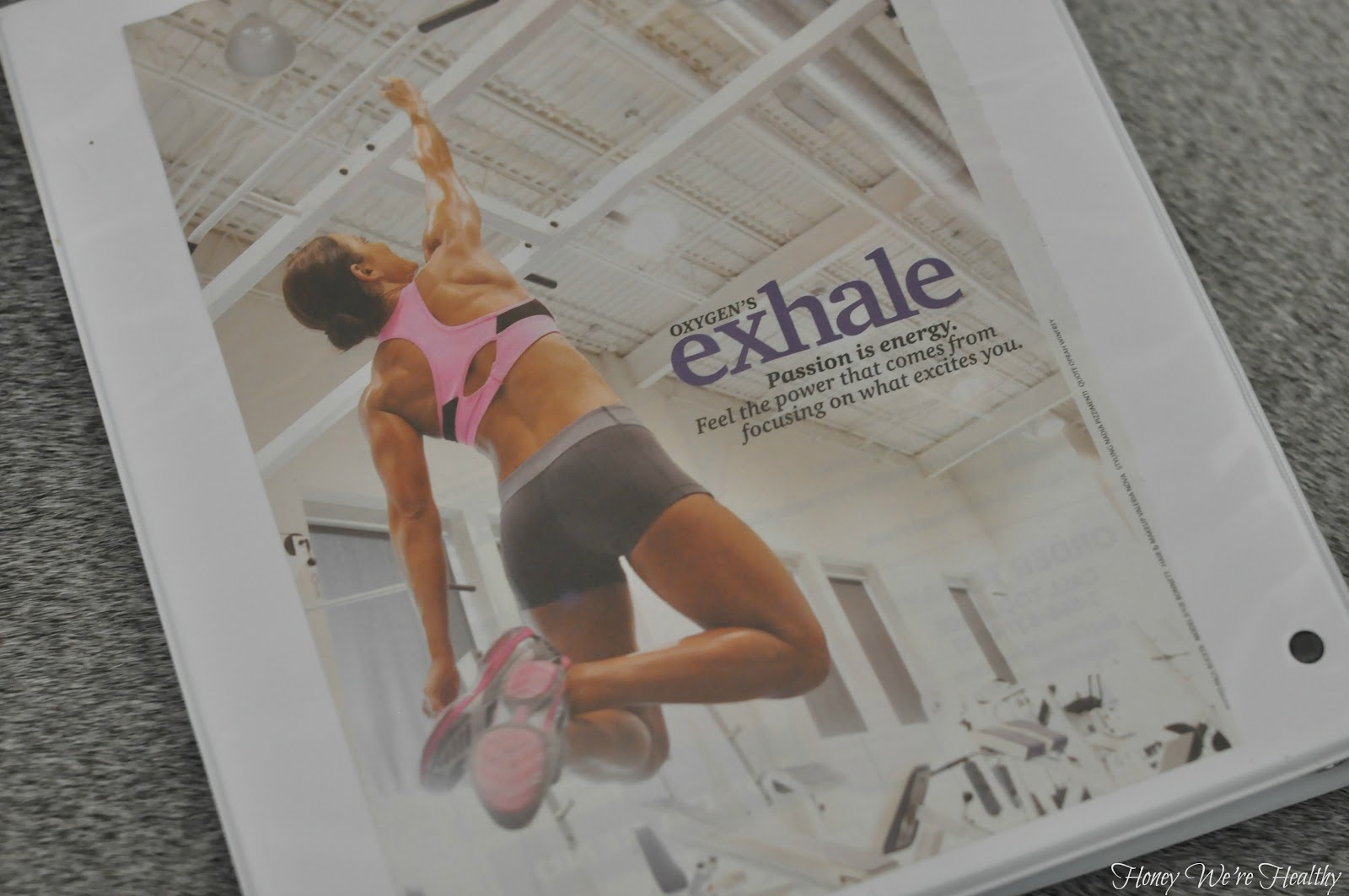
I have printed out all of the workouts from the 12-week program and keep them in a binder, along with my measurements so I can track my progress.  The binder is just an inexpensive 1-inch white three-ring binder with a plastic cover, so I inserted something to motivate me on the front. 


I love the shot of this strong woman climber and the quote that accompanies it.  


And on the back, I included a shot of a muscular and feminine physique I admire.  That booty- dang! 


Those pages are from Oxygen magazine.  The binder lives in my workout bag along with my mini i-Pod, workout gloves, and water bottle.  

How do you keep track of your workouts?

* * * * * 


spin class

running


Santosha: Happiness and Longevity

by Ram

In the Sadhana Pada of the Yoga Sutras by Patanjali we are introduced to the eight rungs/limbs/steps of yoga whose practice helps us to develop attention as a tool to discriminate between ignorance and awareness and truth from illusion which is the means for liberation or enlightenment. The first two of these rungs or limbs are the yamas and niyamas that can be looked at as universal morality and personal observances. The practices of yamas and niyamas lay the foundation from which to develop all the other subtle practices. The second limb contains the five niyamas or observances/practices of self-training, and deals with how we relate to ourselves inwardly. One of the five niyamas is santosha, which means contentment or true happiness.

Santosha Anuttamah Sukha Labhah

From an attitude of contentment/true happiness (santosha), mental comfort, joy, and satisfaction (anuttamah sukha) are obtained. —Swami Jnaneshvara  


To be contented and happy, even while experiencing life’s difficulties, becomes a process of growth through all kinds of circumstances (see Yoga and the Pursuit of Happiness). We should accept that there is a purpose for everything and we cultivate contentment to accept what happens. It means being happy with what we have rather than being unhappy about what we don't have. Humans seem to always be seeking satisfaction in the materialistic world and our internal fantasies. However, if we are contented with our wants, wishes and needs and truly happy with our lifestyle and what we currently have, it will help us in the journey to absolute truth and the highest realization. Discontentment and unhappiness arises when we get caught up in this materialistic world. Our desires and needs for material possessions, if left unfulfilled, create frustration, anger and loss of mental peace, leading to a disharmonious life (see Anger Management: Philosophy, Science and Yoga).
Chicken on Hawaii Beach by Brad Gibson
People are looking for ways to bring that peace and santosha in their lives, and so not surprisingly santosha seems to be the most sought after "principle" in the world today. Your own test for santosha would be about whether you respond through the five senses and react to the changes in all the circumstances of life or whether you listen to your inner voice and are not swayed by the material instincts.

In my previous post  I emphasized the principle of karmayoga or selfless service (see Selfless Service for Harmonious Longevity). Karmayogis are known to constantly live in a world of true happiness. What could you possibly achieve by experiencing true happiness? Among several other benefits, true happiness is now known to extend longevity. Happy people have an advantage over unhappy ones—they are not only healthier but they may also live longer. This is the conclusion drawn from a review published in Applied Psychology: Health and Well-Being thus confirming the need to be happy for a healthy living as advocated in the yoga sutras. The research study compared 160 studies that examined several types of emotions defined as subjective well being (SWB). These included life satisfaction, optimism, hopefulness, sense of humor and other positive emotions. The summary of the findings include:
  1. Happy people exhibited a high SWB as compared to less happy individuals.
  2. Happy people with a high SWB had better health and longevity.
  3. A high SWB (exhibited by happy people) was related to lower mortality rate in both healthy and diseased populations.
  4. Unhappy and stressed people (having a low SWB) had higher blood pressure levels and low immune response as compared to happy people with high SWB.
The above together with other findings suggest that happiness measured as subjective well being causally influences health and longevity. So how about bringing that santosha in your own lives as well? It’s no wonder that Bobby McFerrin gyrated and swooned to the tunes of “Don't Worry, Be Happy.”

Drs. Francisco Cervantes and Marivic Torregosa, and the 2013 Ancestral Health Symposium


Last year I traveled to South Korea to give presentations on nonlinear structural equation modeling and WarpPLS (). These are an advanced statistical analysis technique and related software tool, respectively, which have been used extensively in this blog to analyze health data, notably data related to the China Study.

I gave a couple of presentations at Korea University, which is in Seoul, and a keynote address at a conference in Gwangju, in the south part of the country. So I ended up seeing quite a lot of this beautiful country, and meeting many people. Some of my impressions regarding health and lifestyle issues need separate blog posts, which are forthcoming.

One issue that kept me thinking, as it did when I visited Japan a few years ago as well, was the obvious leanness of the South Koreans, compared with Americans, even though you don’t see a lot of emphasis on dieting there. Interestingly, this phenomenon also poses a challenge to many dietary schools of thought. For example, consumption of high-glycemic-index carbohydrates seems to be relatively high in South Korea.

The relative leanness of South Koreans is probably due to a combination of factors. A major one, it seems, is often forgotten. It is related to epigenetics. This term, “epigenetics”, is often assigned different meanings depending on the context in which it is used. Here it is used to refer to innate predispositions that don’t have a primarily genetic basis.

Epigenetic phenomena often give the impression that acquired characteristics can be inherited, and are frequently, and misguidedly, used as examples in support of a theory often associated with Jean-Baptiste Pierre Antoine de Monet, better known as Lamarck.

A classic example of epigenetics, in this context, is that of a mother with type II diabetes giving birth to a child that will develop type II diabetes at a young age. Typically type II diabetes develops in adults, but its incidence in children has been increasing lately, particularly in certain areas. And I think that this classic example is in part related to the general leanness of South Koreans and of people in other cultures where adoption of highly industrialized foods has been relatively slow.

In other words, I think that it is possible that a major protection in South Korea, as well as in Japan and other countries, is the cultural resistance, particularly among older generations, against adopting modern diets and lifestyles that deviate from their traditional ones.

This brings me to Drs. Francisco Cervantes and Marivic Torregosa (pictured below). Dr. Cervantes is the Chief Director of Laredo Pediatrics and Neonatology, a pediatrician who studied and practiced in a variety of places, including Mexico, New Jersey, and Texas. Dr. Torregosa is a colleague of mine, a college professor and nurse practitioner in Laredo, with a Ph.D. in nursing and a research interest in child obesity.


As it turns out, Laredo, a city in Southwestern Texas near the border with Mexico, seems like the opposite of South Korea in terms of health, and this may well be related to epigenetics. This presents an enormous opportunity for research, and for helping people who really need help.

In Laredo, as well as in other areas where insulin resistance and type II diabetes are rampant, there is a great deal of variation in health. There are very healthy folks in Laredo, and very sick ones. This great deal of variation is very useful in the identification of causative factors through advanced statistical analyses. Lack of variation tends to have the opposite effect, often “hiding” causative effects.

Drs. Cervantes, Torregosa, and I had a presentation accepted for the 2013 Ancestral Health Symposium (). It is titled “Gallbladder Disease in Children: Separating Myths from Facts”. It is entirely based on data collected and analyzed by Dr. Cervantes, who is very knowledgeable about statistics. Below is the abstract.

Cholesterol’s main role in the body is to serve as raw material for bile acids; the conversion of cholesterol to bile acids by the liver accounts for approximately 70 percent of the daily disposal of cholesterol. Bile acids are then stored in the gallbladder and secreted to aid in the digestion of dietary fat. It is often believed that high cholesterol levels cause gallbladder disease. In this presentation, we will discuss various aspects of gallbladder disease, with a focus on children. The presentation will be based on data from 2116 patients of the Laredo Pediatrics & Neonatology. The patients, 1041 boys and 1075 girls, are largely first generation American-born children of Hispanic descent; a group at very high risk of developing gallbladder disease. This presentation will dispel several myths, and lay out a case for a strong association between gallbladder disease and abnormally high body fat levels. Gallbladder disease appears to be largely preventable in children through diet and lifestyle modifications, some of which will be discussed during the presentation.

Many people seem to be unaware of the fact that cholesterol production and disposal are strongly associated with secretion of bile acids. Most of the body's cholesterol is used to produce bile acids, which are reabsorbed from the gut, in a cyclical process. This is the reason behind the use of "bile acid sequestrants" to reduce cholesterol levels.

The focus on gallbladder disease in the presentation comes from an interest by Dr. Cervantes, based on his many years of clinical experience, in using gallbladder disease markers to identify and prevent other conditions, including several conditions associated with what we refer to as diseases of affluence or civilization.

Dr. Cervantes is unique among clinical practitioners in that he spends a lot of time analyzing data from his patients. His knowledge of data analyses techniques rivals that of many professional researchers I know. And he does that at his own expense, something that most clinical practitioners are unwilling to do. Dr. Cervantes and I will be co-authoring blog posts here in the future.

Friday, March 22, 2013

Healthy Spirits: New Arrivals CASTRO

1.  Panil Barriquee Sour Red Ale

2. Anchorage Tide & Its Takers

3. Jolly Pumpkin Oro De Calabaza

4. Dieu Du Ciel! Peche Mortel Imperial Coffee Stout

5. Beer Here Kama Citra

6. Thornbridge Hall Halcyon,Jaipur IPA, Kipling, St. Petersburg Russian Stout

7. Cuvee Des Jonquilles

Friday Q&A: Yoga Nidra, Restorative Yoga, Meditation and Savasana

Q:  I recently started listening to Rod Stryker's Yoga Nidra CD. I shut my office door at lunch, lay out my mat and this week have finally made it through the short session without falling asleep. (I don't like writing "made it", as that sounds like a burden and it's not, it's wonderful). This started me wondering about the difference in the expected results between Yoga Nidra, the restorative yoga that I sometimes do at night, meditation (which I'm definitely a novice at), Savasana...
 

I want to thank all of you for your efforts in sharing your thoughts. It is a gift that I appreciate very much.”

A: Thanks for this great question, about which I could quite honestly get long winded, since several of the topics are quite complex.  I will try to be succinct in sussing out a few helpful distinctions.  I’d like to start by talking about restorative yoga for a moment. The name kinda gives this one away: the practice of these supported asana are said to be restorative for the practitioner.  Well, on what level?  Could be physically, mentally, emotionally, or even spiritually restorative. These postures are usually done on the ground either sitting or reclining over supportive props. A few we have looked at on this blog include Supported Savasana, Supported Reclined Cobblers Pose, and Supported Child’s Pose.  Once you get set up in the pose, you are simply allowing your body to rest in the position you find yourself in. From there, you could conceivably do some sort of meditation or listen to a recorded yoga nidra, as this writer has been doing lately.  To view and read more about restorative yoga, check out Judith Lasater’s classic book Relax and Renew.

Savasana, which has come to be associated as the final pose of the physical practice of yoga in most classes around this country, is done in the supine position.  In its simplest form, you simply lie down on your back without any support other than your sticky mat. However, you could do a more restorative version, or at least more supported version, like our version with the shin bones up on a chair seat. Its purpose can be to simply provide a brief rest for the physical body following your active asana practice, or it could be an opportunity for a guided meditation led by your teacher or a recording, or a self-guided meditation such as simple moment-by-moment breath awareness.  It has been proposed by several of my teachers that Savasana has the purpose of allowing the practice to be integrated into our bodies and minds to assist in gradual changes brought about by yoga. It is likened to letting a cake “set-up” on the counter after baking in the oven to allow the flavors to fully blend and mix before biting in for a taste. I love those food metaphors!  Now I want a piece of cake!

Meditation is a huge topic, but suffice it to say that we often do several simple meditation techniques in modern yoga classes that are “mindfulness exercises” in which we keep bringing our awareness back to a predetermined focus for the period of the meditation. Paramount among several possible purposes is the famous one from the Yoga Sutra of Patanjali, to quiet the mental chatter or “fluctuations of consciousness” (as one translator put it).  However, there are other purposes both in the hatha yoga tradition as well as aligned traditions, such as the Buddhist tradition, including using your meditation to transform the suffering of others into an inner peacefulness.

And finally, the yoga nidra we practice today was developed by Swami Satyananda Saraswati in the 1940s, and is discussed in his book Yoga Nidra. In his book, he claims to have developed this yoga nidra technique, which I feel is a kind of near subliminal suggestion or learning, by blending a seated meditation practice that is very old with more modern psychology techniques. And, just as in the CD our questioner has been listening to, even though you are encouraged to stay lightly awake and attentive during the session - which is usually from 20-45 minutes in length (a whole lot longer than our usual Savasana!) - you supposedly still get benefits even if you fall asleep.  In addition to the deep sense of relaxation that usually results, you are asked to set an intention or sankalpa at that the start of the yoga nidra. You are choosing, essentially, something that you want the yoga nidra to help you bring to fruition. You are asked to remind yourself of the same intention at the very end of the practice as well, so it is at the forefront of your consciousness when you are done.

So, these four tools of yoga share some similarities, yet they each have some unique distinctions as well. Hopefully this discussion will start to bring greater clarity to each of them for you. And they are all wonderful to practice, so try them out this coming week in your home practice to see what differences you can observe yourself.

—Baxter

Thursday, March 21, 2013

The Power of Fact Checking: Timothy McCall on Elephant Journal

by Nina

Buddha Waiting for Spring by Michele Macartney-Filgate
Just a quick announcement today to let you know that Timothy has a very interesting post up now on Elephant Journal Does Yoga Kill?

Recently Timothy wrote about yoga and strokes on our blog (see Will Yoga Cause a Stroke? Could It Prevent One?), covering the topic in general and how to practice yoga safely. In his Elephant Journal post, however, Timothy directly takes on New York Times science writer William Broad’s claims about the relationship between yoga and strokes, responding point by point to Broad’s claims and looking more deeply into the research that Broad used to back them up. All I can say is, wow, that fact checking thing is really amazing—wonder why Broad's editors didn’t avail themselves.

My favorite fact is this one:

“To bolster his case, he listed several people whose deaths might have been caused by yoga including this one: “In Los Angeles in 2004, Sita White, 43, a British heiress and a favorite of gossip columnists, collapsed and died in a yoga class. The question is why.”

What Broad neglected to mention is that she wasn’t doing yoga at the time. According to eyewitnesses and media reports, White collapsed and died while students were filing in and putting down their mats.”


I also love Timothy’s conclusion:

“The truth, on the other hand, is often complicated, nuanced, and doesn’t always make a great story. And it is precisely that satya—subtle, interpenetrating, endlessly unfolding—that yogis are after.”


But you should go ahead and check out this article! And let us know what you think.