Showing posts with label resistance exercise. Show all posts

Monday, July 15, 2013

How can carrying some extra body fat be healthy?


Most of the empirical investigations into the association between body mass index (BMI) and mortality suggest that the lowest-mortality BMI is approximately on the border between the normal and overweight ranges. Or, as Peter put it (): "Getting fat is good."

As much as one may be tempted to explain this based only on the relative contribution of lean body mass to total weight, the evidence suggests that both body fat and lean body mass contribute to this phenomenon. In fact, the evidence suggests that carrying some extra body fat may be healthy for many.

Yet, the scientific evidence strongly suggests that body fat accumulation beyond a certain point is unhealthy. There seems to be a sweet spot of body fat percentage, and that sweet spot may vary a lot across different individuals.

One interesting aspect of most empirical investigations of the association between BMI and mortality is that the participants live in urban or semi-urban societies. When you look at hunter-gatherer societies, the picture seems to be a bit different. The graph below shows the distribution of BMIs among males in Kitava and Sweden, from a study by Lindeberg and colleagues ().


In Sweden, a lowest mortality BMI of 26 would correspond to a point on the x axis that would rise up approximately to the middle of the distribution of data points from Sweden in the graph. It is reasonable to assume that this would also happen in Kitava, in which case the lowest mortality BMI would be around 20.

One of the key differences between urbanites and hunter-gatherers is the greater energy expenditure among the latter; hunter-gatherers generally move more. This provides a clue as to why some extra body fat may be healthy among urbanites. Hunter-gatherers spend more energy, so they have to consume more “natural” food, and thus more nutrients, to maintain their lean body mass.

A person’s energy expenditure is strongly dependent on a few variables, including body weight and physical activity. Let us assume that a hunter-gatherer, due to a reasonably high level of physical activity, maintains a BMI of 20 while consuming 3,000 kilocalories (a.k.a. calories) per day. An urbanite with the same height, but a lower level of physical activity, may need a higher body weight, and thus a higher BMI, to consume 3,000 calories per day at maintenance.

And why would someone want to consume 3,000 calories per day? Why not 1,500? The reason is nutrient intake, particularly micronutrient intake – intake of vitamins and minerals that are used by the body in various processes. Unfortunately it seems that micronutrient supplementation (e.g., a multivitamin pill) is largely ineffective except in cases of pathological deficiency.

Urbanites may need to carry a bit of extra body fat to be able to have an appropriate intake of micronutrients to maintain their lean body structures in a healthy state. Obviously the type of food eaten matters a lot. A high nutrient-to-calorie ratio is generally desirable. However, we cannot forget that we also need to eat fat, in part because without it we cannot properly absorb the all-important fat-soluble vitamins. And dietary fat is the most calorie-dense nutrient of all.

Why not putting on extra muscle instead of carrying the extra fat? For one, that is not easy when you are a sedentary urbanite. Particularly after a certain age, if you try too hard you end up getting injured. But there is another interesting angle to consider. Humans, like many other animals, have genetic “protections” against high muscularity, such as the protein myostatin. Myostatin is produced mostly in muscle cells; it acts on muscle, by inhibiting its growth.

Say what? Why would evolution favor something like myostatin? Big, muscular humans could be at the top of the food chain by physical strength alone; they could kill a lion with their bare hands. Well, it is possible. (Many men like to think of themselves as warriors, probably because most of them are not.) But evolution favors what works best given the ecological niches available. In our case, it favored bigger and more plastic brains to occupy what Steve Pinker called a “cognitive niche”.

Even though fat mass is not inert, secreting a number of hormones into the bloodstream, the micronutrient “need” of fat mass is likely much lower than the micronutrient need of non-fat mass. That is, a kilogram of lean mass likely puts a higher demand on micronutrients than a kilogram of fat mass. This should be particularly the case for organs, such as the liver, but also applies to muscle tissue.

While gaining muscle mass through moderate exercise is extremely healthy, bulking up beyond one’s natural limitations may actually backfire. It could increase the demand for micronutrients above what a person can actually consume and absorb through a healthy nutritious diet. Some extra fat mass allows for a higher level of micronutrient intake at weight maintenance, with a lower demand for micronutrients than the same amount of extra lean mass.

Some people are naturally more muscular. Their frame and underlying organ-based capabilities probably support that. It is often visibly noticeable when they go beyond their organ-based capabilities. A common trait among many professional bodybuilders, who usually go beyond the genetic gifts that they naturally have, is an abnormal swelling of internal organs.

What complicates this discussion is that all of this seems to vary from individual to individual. People have to find their sweet spots, and doing that may not be the simplest of tasks. For example, even measuring body fat percentage with some precision is difficult and costly. Also, certain types of fat are less desirable than others – visceral versus subcutaneous body fat. It is not easy differentiating one from the other ().

How do you find your sweet spot in terms of body fat percentage? One of the most promising approaches is to find the point at which your waist-to-weight ratio is minimized ().

Monday, January 2, 2012

HCE user experience: The anabolic range may be better measured in seconds than repetitions

It is not uncommon for those who do weight training to see no gains over long periods of time for certain weight training exercises (e.g., overhead press), even while they experience gains in other types of exercise (e.g., regular squats).

HealthCorrelator for Excel (HCE) and its main outputs, coefficients of association and graphs (), have been helping some creative users identify the reasons why they see no gains, and break out of the stagnation periods.

It may be a good idea to measure the number of seconds of effort per set; in addition to other variables such as numbers of sets and repetitions, and the amount of weight lifted. In some cases, an inverted J curve, full or partial (just the left side of it), shows up suggesting that the number of seconds of effort in a particular type of weight training exercise is a better predictor of muscle gain than the number of repetitions used.

The inverted J curve is similar to the one discussed in a previous post on HCE used for weight training improvement, where the supercompensation phenomenon is also discussed ().

Repetitions in the 6-12 range are generally believed to lead to peak anabolic response, and this is generally true for weight training exercises conducted in good form and to failure. It is also generally believed that muscular effort should be maintained for 20 to 120 seconds for peak anabolic response.

The problem is that in certain cases not even 12 repetitions lead to at least 20 seconds of effort. This is usually the case when the repetitions are performed very quickly. There are a couple of good reasons why this may happen: the person has above-average muscular power, or the range of motion used is limited.

What is muscular power, and why would someone want to limit the range of motion used in a weight training exercise?

Muscular power is different from muscular strength, and is normally distributed (bell curve) across the population, like most human traints (). Muscular power is related to the speed with which an individual can move a certain amount of weight. Muscular strength is related to the amount of weight moved. Frequently people who perform amazing feats of strength, like Dennis Rogers (), have above-average muscular power.

As for limiting the range of motion used in a weight training exercise, one of the advantages of doing so is that it reduces the risk of injury, as a wise commenter pointed out here some time ago (). It also has the advantage of increasing the number of variations of an exercise that can be used at different points in time; which is desirable, as variation is critical for sustained supercompensation ().

The picture below is from a YouTube video clip showing champion natural bodybuilder Doug Miller performing 27 repetitions of the deadlift with 405 lbs (). Doug is one of the co-authors of the book Biology for Bodybuilders, which has been reviewed here ().


The point of showing the video clip above is that the range of repetitions used would be perceived as quite high by many bodybuilders, but is nevertheless the one leading to a peak anabolic response for Doug. If you pay careful attention to the video, you will notice that Doug completes the 27 repetitions in 45 seconds, well within the anabolic range. If he had completed only 12 repetitions, at about the same pace, he would have done that a few seconds before hitting the 20-second mark.

Doug completes those 27 repetitions relatively quickly, because he has above-average muscular power, in addition to having above-average muscular strength.

Monday, December 19, 2011

Protein powders before fasted weight training? Here is a more natural and cheaper alternative

The idea that protein powders should be consumed prior to weight training has been around for a while, and is very popular among bodybuilders. Something like 10 grams or so of branched-chain amino acids (BCAAs) is frequently recommended. More recently, with the increase in popularity of intermittent fasting, it has been strongly recommended prior to “fasted weight training”. The quotation marks here are because, obviously, if you are consuming anything that contains calories prior to weight training, the weight training is NOT being done in a fasted state.

(Source: Ecopaper.com)

Most of the evidence available suggests that intermittent fasting is generally healthy. In fact, being able to fast for 16 hours or more, particularly without craving sweet foods, is actually a sign of a healthy glucose metabolism; which may complicate a cause-and-effect analysis between intermittent fasting and general health. The opposite, craving sweet foods every few hours, is generally a bad sign.

One key aspect of intermittent fasting that needs to be highlighted is that it is also arguably a form of liberation ().

Now, doing weight training in the fasted state may or may not lead to muscle loss. It probably doesn’t, even after a 24-hour fast, for those who fast and replenish their glycogen stores on a regular basis ().

However, weight training in a fasted state frequently induces an exaggerated epinephrine-norepinephrine (i.e., adrenaline-noradrenaline) response, likely due to depletion of liver glycogen beyond a certain threshold (the threshold varies for different people). The same is true for prolonged or particularly intense weight training sessions, even if they are not done in the fasted state. The body wants to crank up consumption of fat and ketones, so that liver glycogen is spared to ensure that it can provide the brain with its glucose needs.

Exaggerated epinephrine-norepinephrine responses tend to cause a few sensations that are not very pleasant. One of the first noticeable ones is orthostatic hypotension; i.e., feeling dizzy when going from a sitting to a standing position. Other related feelings are light-headedness, and a “pins and needles” sensation in the limbs (typically the arms and hands). Many believe that they are having a heart attack whey they have this “pins and needles” sensation, which can progress to a stage that makes it impossible to continue exercising.

Breaking the fast prior to weight training with dietary fat or carbohydrates is problematic, because those nutrients tend to blunt the dramatic rise in growth hormone that is typically experienced in response to weight training (). This is not good because the growth hormone response is probably one of the main reasons why weight training can be so healthy ().

Dietary protein, however, does not seem to significantly blunt the growth hormone response to weight training; even though it doesn't seem to increase it either (). Dietary protein seems to also suppress the exaggerated epinephrine-norepinephrine response to fasted weight training. And, on top of all that, it appears to suppress muscle loss, which may well be due to a moderate increase in circulating insulin ().

So everything points at the possibility that the ingestion of some protein, without carbohydrates or fat, is a good idea prior to fasted weight training. Not too much protein though, because insulin beyond a certain threshold is also likely to suppress the growth hormone response.

Does the protein have to be in the form of a protein powder? No.

Supplements are made from food, and this is true of protein powders as well. If you hard-boil a couple of large eggs, and eat only the whites prior to weight training, you will be getting about 8-10 grams of one of the highest quality protein "supplements" you can possibly get. Included are BCAAs. You will get a few extra nutrients with that too, but virtually no fat or carbohydrates.

Monday, December 12, 2011

Finding your sweet spot for muscle gain with HCE

In order to achieve muscle gain, one has to repeatedly hit the “supercompensation” window, which is a fleeting period of time occurring at some point in the muscle recovery phase after an intense anaerobic exercise session. The figure below, from Vladimir Zatsiorsky’s and William Kraemer’s outstanding book Science and Practice of Strength Training () provides an illustration of the supercompensation idea. Supercompensation is covered in more detail in a previous post ().


Trying to hit the supercompensation window is a common denominator among HealthCorrelator for Excel (HCE) users who employ the software () to maximize muscle gain. (That is, among those who know and subscribe to the theory of supercompensation.) This post outlines what I believe is a good way of doing that while avoiding some pitfalls. The data used in the example that follows has been created by me, and is based on a real case. I disguised the data, simplified it, added error etc. to make the underlying method relatively easy to understand, and so that the data cannot be traced back to its “real case” user (for privacy).

Let us assume that John Doe is an intermediate weight training practitioner. That is, he has already gone through the beginning stage where most gains come from neural adaptation. For him, new gains in strength are a reflection of gains in muscle mass. The table below summarizes the data John obtained when he decided to vary the following variables in order to see what effects they have on his ability to increase the weight with which he conducted the deadlift () in successive exercise sessions:
    - Number of rest days in between exercise sessions (“Days of rest”).
    - The amount of weight he used in each deadlift session (“Deadlift weight”).
    - The amount of weight he was able to add to the bar each session (“Delta weight”).
    - The number of deadlift sets and reps (“Deadlift sets” and “Deadlift reps”, respectively).
    - The total exercise volume in each session (“Deadlift volume”). This was calculated as follows: “Deadlift weight” x “Deadlift sets” x “Deadlift reps”.


John’s ability to increase the weight with which he conducted the deadlift in each session is measured as “Delta weight”. That was his main variable of interest. This may not look like an ideal choice at first glance, as arguably “Deadlift volume” is a better measure of total effort and thus actual muscle gain. The reality is that this does not matter much in his case, because: John had long rest periods within sets, of around 5 minutes; and he made sure to increase the weight in each successive session as soon as he felt he could, and by as much as he could, thus never doing more than 24 reps. If you think that the number of reps employed by John is too high, take a look at a post in which I talk about Doug Miller and his ideas on weight training ().

Below are three figures, with outputs from HCE: a table showing the coefficients of association between “Delta weight” and the other variables, and two graphs showing the variation of “Delta weight” against “Deadlift volume” and “Days of rest”. As you can see, nothing seems to be influencing “Delta weight” strongly enough to reach the 0.6 level that I recommend as the threshold for a “real effect” to be used in HCE analyses. There are two possibilities here: it is what it looks it is, that is, none of the variables influence “Delta weight”; or there are effects, but they do not show up in the associations table (as associations equal to or greater than 0.6) because of nonlinearity.


The graph of “Delta weight” against “Deadlift volume” is all over the place, suggesting a lack of association. This is true for the other variables as well, except “Days of rest”; the last graph above. That graph, of “Delta weight” against “Days of rest”, suggests the existence of a nonlinear association with the shape of an inverted J curve. This type of association is fairly common. In this case, it seems that “Delta weight” is maximized in the 6-7 range of “Days of rest”. Still, even varying things almost randomly, John achieved a solid gain over the time period. That was a 33 percent gain from the baseline “Deadlift weight”, a gain calculated as: (285-215)/215.

HCE, unlike WarpPLS (), does not take nonlinear relationships into consideration in the estimation of coefficients of association. In order to discover nonlinear associations, users have to inspect the graphs generated by HCE, as John did. Based on his inspection, John decided to changes things a bit, now working out on the right side of the J curve, with 6 or more “Days of rest”. That was difficult for John at first, as he was addicted to exercising at a much higher frequency; but after a while he became a “minimalist”, even trying very long rest periods.

Below are four figures. The first is a table summarizing the data John obtained for his second trial. The other three are outputs from HCE, analogous to those obtained in the first trial: a table showing the coefficients of association between “Delta weight” and the other variables, two graphs (side-by-side) showing “Delta weight” against “Deadlift sets” and “Deadlift reps”, and one graph of “Delta weight” against “Days of rest”. As you can see, “Days of rest” now influences “Delta weight” very strongly. The corresponding association is a very high -0.981! The negative sign means that “Delta weight” decreases as “Days of rest” increase. This does NOT mean that rest is not important; remember, John is now operating on the right side of the J curve, with 6 or more “Days of rest”.


The last graph above suggests that taking 12 or more “Days of rest” shifted things toward the end of the supercompensation window, in fact placing John almost outside of that window at 13 “Days of rest”. Even so, there was no loss of strength, and thus probably no muscle loss. Loss of strength would be suggested by a negative “Delta weight”, which did not occur (the “Delta weight” went down to zero, at 13 “Days of rest”). The two graphs shown side-by-side suggest that 2 “Deadlift sets” seem to work just as well for John as 3 or 4, and that “Deadlift reps” in the 18-24 range also work well for John.

In this second trial, John achieved a better gain over a similar time period than in the first trial. That was a 36 percent gain from the baseline “Deadlift weight”, a gain calculated as: (355-260)/260. John started with a lower baseline than in the end of the first trial period, probably due to detraining, but achieved a final “Deadlift weight” that was likely very close to his maximum potential (at the reps used). Because of this, the 36 percent gain in the period is a lot more impressive than it looks, as it happened toward the end of a saturation curve (e.g., the far right end of a logarithmic curve).

One important thing to keep in mind is that if an HCE user identifies a nonlinear relationship of the J-curve type by inspecting the graphs like John did, in further analyses the focus should be on the right or left side of the curve by either: splitting the dataset into two, and running a separate analysis for each new dataset; or running a new trial, now sticking with a range of variation on the right or left side of the curve, as John did. The reason is that nonlinear relationships tend to distort the linear coefficients calculated by HCE, hiding a real relationship between two variables.

This is a very simplified example. Most serious bodybuilders will measure variations in a number of variables at the same time, for a number of different exercise types and formats, and for longer periods. That is, their “HealthData” sheet in HCE will be a lot more complex. They will also have multiple instances of HCE running on their computer. HCE is a collection of sheets and code that can be copied, and saved with different names. The default is “HCE_1_0.xls” or “HCE_1_0.xlsm”, depending on which version you are using. Each new instance of HCE may contain a different dataset for analysis, stored in the “HealthData” sheet.

It is strongly recommended that you keep your data in a separate set of sheets, as a backup. That is, do not store all your data in the “HealthData” sheets in different HCE instances. Also, when you copy your data into the “HealthData” sheet in HCE, copy only the values and formats, and NOT the formulas. If you copy the formulas, you may end up having some problems, as some of the cells in the “HealthData” sheet will not be storing values. I also recommend storing values for other types variables, particularly perception-based variables.

Examples of perception-based variables are: “Perceived stress”, “Perceived delayed onset muscle soreness (DOMS)”, and “Perceived non-DOMS pain”. These can be answered on Likert-type scales, such as scales going from 1 (very strongly disagree) to 7 (very strongly agree) in response to self-prepared question-statements like “I feel stressed out” (for “Perceived stress”). If you find that a variable like “Perceived non-DOMS pain” is associated with working out at a particular volume range, that may help you avoid serious injury in the future, as non-DOMS pain is not a very good sign (). You also may find that working out in the volume range that is associated with non-DOMS pain adds nothing in terms of muscle gain.

Generally speaking, I think that many people will find out that their sweet spot for muscle gain involves less frequent exercise at lower volumes than they think. Still, each individual is unique; there is no one quite like John. The relationship between “Delta weight” and “Days of rest” varies from person to person based on age; older folks generally require more rest. It also varies based on whether the person is dieting or not; less food intake leads to longer recovery periods. Women will probably see visible lower-body muscle gain, but very little visible upper-body muscle gain (in the absence of steroid use), even as they experience upper-body strength gains. Other variables of interest for both men and women may be body weight, body fat percentage, and perceived muscle tone.

Monday, July 18, 2011

Dietary protein does not become body fat if you are on a low carbohydrate diet

By definition LC is about dietary carbohydrate restriction. If you are reducing carbohydrates, your proportional intake of protein or fat, or both, will go up. While I don’t think there is anything wrong with a high fat diet, it seems to me that the true advantage of LC may be in how protein is allocated, which seems to contribute to a better body composition.

LC with more animal protein and less fat makes particularly good sense to me. Eating a variety of unprocessed animal foods, as opposed to only muscle meat from grain-fed cattle, will get you that. In simple terms, LC with more protein, achieved in a natural way with unprocessed foods, means more of the following in one's diet: lean meats, seafood and vegetables. Possibly with lean meats and seafood making up more than half of one’s protein intake. Generally speaking, large predatory fish species (e.g., various shark species, including dogfish) are better avoided to reduce exposure to toxic metals.

Organ meats such as beef liver are also high in protein and low in fat, but should be consumed in moderation due to the risk of hypervitaminosis; particularly hypervitaminosis A. Our ancestors ate the animal whole, and organ mass makes up about 10-20 percent of total mass in ruminants. Eating organ meats once a week places you approximately within that range.

In LC liver glycogen is regularly depleted, so the amino acids resulting from the digestion of protein will be primarily used to replenish liver glycogen, to replenish the albumin pool, for oxidation, and various other processes (e.g., tissue repair, hormone production). If you do some moderate weight training, some of those amino acids will be used for muscle growth.

In this sense, the true “metabolic advantage” of LC, so to speak, comes from protein and not fat. “Calories in” still counts, but you get better allocation of nutrients. Moreover, in LC, the calorie value of protein goes down a bit, because your body is using it as a “jack of all trades”, and thus in a less efficient way. This renders protein the least calorie-dense macronutrient, yielding fewer calories per gram than carbohydrates; and significantly fewer calories per gram when compared with dietary fat and alcohol.

Dietary fat is easily stored as body fat after digestion. In LC, it is difficult for the body to store amino acids as body fat. The only path would be conversion to glucose and uptake by body fat cells, but in LC the liver will typically be starving and want all the extra glucose for itself, so that it can feed its ultimate master – the brain. The liver glycogen depletion induced by LC creates a hormonal mix that places the body in fat release mode, making it difficult for fat cells to take up glucose via the GLUT4 transporter protein.

Excess amino acids are oxidized for energy. This may be why many people feel a slight surge of energy after a high-protein meal. (A related effect is associated with alcohol consumption, which is often masked by the relaxing effect also associated with alcohol consumption.) Amino acid oxidation is not associated with cancer. Neither is fat oxidation. But glucose oxidation is; this is known as the Warburg effect.

A high-protein LC approach will not work very well for athletes who deplete major amounts of muscle glycogen as part of their daily training regimens. These folks will invariably need more carbohydrates to keep their performance levels up. Ultimately this is a numbers game. The protein-to-glucose conversion rate is about 2-to-1. If an athlete depletes 300 g of muscle glycogen per day, he or she will need about 600 g of protein to replenish that based only on protein. This is too high an intake of protein by any standard.

A recreational exerciser who depletes 60 g of glycogen 3 times per week can easily replenish that muscle glycogen with dietary protein. Someone who exercises with weights for 40 minutes 3 times per week will deplete about that much glycogen each time. Contrary to popular belief, muscle glycogen is only minimally replenished postprandially (i.e., after meals) based on dietary sources. Liver glycogen replenishment is prioritized postprandially. Muscle glycogen is replenished over several days, primarily based on liver glycogen. It is one fast-filling tank replenishing another slow-filling one.

Recreational exercisers who are normoglycemic and who do LC intermittently tend to increase the size of their liver glycogen tank over time, via compensatory adaptation, and also use more fat (and ketones, which are byproducts of fat metabolism) as sources of energy. Somewhat paradoxically, these folks benefit from regular high carbohydrate intake days (e.g., once a week, or on exercise days), since their liver glycogen tanks will typically store more glycogen. If they keep their liver and muscle glycogen tanks half empty all the time, compensatory adaptation suggests that both their liver and muscle glycogen tanks will over time become smaller, and that their muscles will store more fat.

One way or another, with the exception of those with major liver insulin resistance, dietary protein does not become body fat if you are on a LC diet.

Monday, May 16, 2011

Book review: Biology for Bodybuilders

The photos below show Doug Miller and his wife, Stephanie Miller. Doug is one of the most successful natural bodybuilders in the U.S.A. today. He is also a manager at an economics consulting firm and an entrepreneur. As if these were not enough, now he can add book author to his list of accomplishments. His book, Biology for Bodybuilders, has just been published.

(Source: www.dougmillerpro.com)

Doug studied biochemistry, molecular biology, and economics at the undergraduate level. His co-authors are Glenn Ellmers and Kevin Fontaine. Glenn is a regular commenter on this blog, a professional writer, and a certified Strength and Conditioning Specialist. Dr. Fontaine is an Associate Professor at the Johns Hopkins University’s School of Medicine and Bloomberg School of Public Health.

Biology for Bodybuilders is written in the first person by Doug, which is one of the appealing aspects of the book. This also allows Doug to say that his co-authors disagree with him sometimes, even as he outlines what works for him. Both Glenn and Kevin are described as following Paleolithic dieting approaches. Doug follows a more old school bodybuilding approach to dieting – e.g., he eats grains, and has multiple balanced meals everyday.

This relaxed approach to team writing neutralizes criticism from those who do not agree with Doug, at least to a certain extent. Maybe it was done on purpose; a smart idea. For example, I do not agree with everything Doug says in the book, but neither do Doug’s co-authors, by his own admission. Still, one thing we all have to agree with – from a competitive sports perspective, no one can question success.

At less than 120 pages, the book is certainly not encyclopedic, but it is quite packed with details about human physiology and metabolism for a book of this size. The scientific details are delivered in a direct and simple manner, through what I would describe as very good writing.

Doug has interesting ideas on how to push his limits as a bodybuilder. For example, he likes to train for muscle hypertrophy at around 20-30 lbs above his contest weight. Also, he likes to exercise at high repetition ranges, which many believe is not optimal for muscle growth. He does that even for mass building exercises, such as the deadlift. In this video he deadlifts 405 lbs for 27 repetitions.

Here it is important to point out that whether one is working out in the anaerobic range, which is where muscle hypertrophy tends to be maximized, is defined not by the number of repetitions but by the number of seconds a muscle group is placed under stress. The anaerobic range goes from around 20 to 120 seconds. If one does many repetitions, but does them fast, he or she will be in the anaerobic range. Incidentally, this is the range of strength training at which glycogen depletion is maximized.

I am not a bodybuilder, nor do I plan on becoming one, but I do admire athletes that excel in narrow sports. Also, I strongly believe in the health-promoting effects of moderate glycogen-depleting exercise, which includes strength training and sprints. Perhaps what top athletes like Doug do is not exactly optimal for long-term health, but it certainly beats sedentary behavior hands down. Or maybe top athletes will live long and healthy lives because the genetic makeup that allows them to be successful athletes is also conducive to great health.

In this respect, however, Doug is one of the people who have gotten the closest to convincing me that genes do not influence so much what one can achieve as a bodybuilder. In the book he shows a photo of himself at age 18, when he apparently weighed not much more than 135 lbs. Now, in his early 30s, he weighs 210-225 lbs during the offseason, at a height of 5'9". He has achieved this without taking steroids. Maybe he is a good example of compensatory adaptation, where obstacles lead to success.

If you are interested in natural bodybuilding, and/or the biology behind it, this book is highly recommended!

Saturday, January 15, 2011

Do you lose muscle if you lift weights after a 24-hour fast? Probably not if you do that regularly

Compensatory adaptation (CA) is an idea that is useful in the understanding of how the body reacts to inputs like dietary intake of macronutrients and exercise. CA is a complex process, because it involves feedback loops, but it leads to adaptations that are fairly general, applying to a large cross-section of the population.

A joke among software developers is that the computer does exactly what you tell it to do, but not necessarily what you want it to do. Similarly, through CA your body responds exactly to the inputs you give it, but not necessarily in the way you would like it to respond. For example, a moderate caloric deficit may lead to slow body fat loss, while a very high caloric deficit may bring body fat loss to a halt.

Strength training seems to lead to various adaptations, which can be understood through the lens provided by CA. One of them is a dramatic increase in the ability of the body to store glycogen, in both liver and muscle. Glycogen is the main fuel used by muscle during anaerobic exercise. Regular strength training causes, over time, glycogen stores to more than double. And about 2.6 the amount of glycogen is also stored as water.

When one looks bigger and becomes stronger as a result of strength training, that is in no small part due to increases in glycogen and water stored. More glycogen stored in muscle leads to more strength, which is essentially a measure of one’s ability to move a certain amount of weight around. More muscle protein is also associated with more strength.

Thinking in terms of CA, the increase in the body’s ability to store glycogen is to be expected, as long as glycogen stores are depleted and replenished on a regular basis. By doing strength training regularly, you are telling your body that you need a lot of glycogen on a regular basis, and the body responds. But if you do not replenish your glycogen stores on a regular basis, you are also sending your body a conflicting message, which is that dietary sources of the substances used to make glycogen are not readily available. Among the substances that are used to make glycogen, the best seems to be the combination of fructose and glucose that one finds in fruits.

Let us assume a 160-lbs untrained person, John, who stored about 100 g of glycogen in his liver, and about 500 g in his muscle cells, before starting a strength training program. Let us assume, conservatively, that after 6 months of training he increased the size of his liver glycogen tank to 150 g. Muscle glycogen storage was also increased, but that is less relevant for the discussion in this post.

Then John fasted for 24 hours before a strength training session, just to see what would happen. While fasting he went about his business, doing light activities, which led to a caloric expenditure of about 100 calories per hour (equivalent to 2400 per day). About 20 percent of that, or 20 calories per hour, came from a combination of blood glucose and ketones. Contrary to popular belief, ketones can always be found in circulation. If only glucose were used, 5 g of glucose per hour would be needed to supply those 20 calories.

During the fast, John’s glucose needs, driven primarily by his brain’s needs, were met by conversion of liver glycogen to blood glucose. His muscle glycogen was pretty much “locked” during the fast; because he was doing only light activities, which rely primarily on fat as fuel. Muscle glycogen is “unlocked” through anaerobic exercise, of which strength training is an instance.

One of the roles of ketones is to spare liver glycogen, delaying the use of muscle protein to make glucose down the road, so the percentage of ketones in circulation in John’s body increased in a way that was inversely proportional to stored liver glycogen. According to this study, after 72 hours fasting about 25 percent of the body’s glucose needs are met by ketones. (This may be an underestimation.)

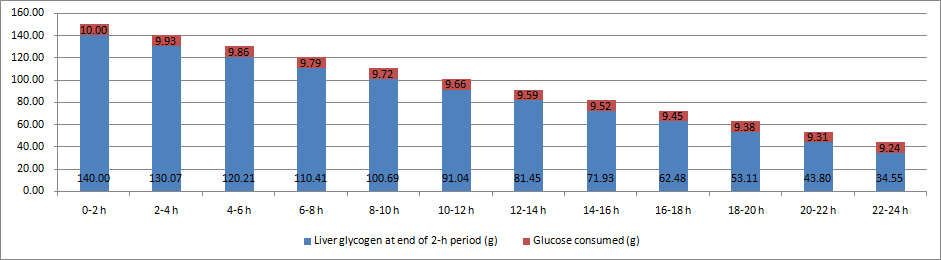
If we assume a linear increase in ketone concentration, this leads to a 0.69 percent increase in circulating ketones for every 2-hour period. (This is a simplification, as the increase is very likely nonlinear.) So, when we look at John’s liver glycogen tank, it probably went down in a way similar to that depicted on the figure below. The blue bars show liver glycogen at the end of each 2-hour period. The red bars show the approximate amount of glucose consumed during each 2-hour period. Glucose consumed goes down as liver glycogen decreases, because of the increase in blood ketones.


As you can see, after a 24-hour fast, John had about 35 g of glycogen left, which is enough for a few extra hours of fasting. At the 24-hour mark the body had no need to be using muscle protein to generate glucose. Maybe some of that happened, but probably not much if John was relaxed during the fast. (If he was stressed out, stress hormones would have increased blood glucose release significantly.) From the body’s perspective, muscle is “expensive”, whereas body fat is “cheap”. And body fat, converted to free fatty acids, is what is used to produce ketones during a fast.

Blood ketone concentration does not go up dramatically during a 24-hour fast, but it does after a 48-hour fast, when it becomes about 10 times higher. This major increase occurs primarily to spare muscle, including heart muscle. If the increase is much smaller during a 24-hour fast, one can reasonably assume that the body is not going to be using muscle during the fast. It can still rely on liver glycogen, together with a relatively small amount of ketones.

Then John did his strength training, after the 24-hour fast. When he did that, the muscles he used in the exercise session converted locally stored glycogen into lactate. A flood of lactate was secreted into the bloodstream, which was used by his liver to produce glucose and also to replenish liver glycogen a bit. Again, at this stage there was no need for John’s body to use muscle protein to generate glucose.

Counterintuitive as this may sound, the more different muscles John used, the more lactate was made available. If John did 20 sets of isolated bicep curls, for example, his body would not have released enough lactate to meet its glucose needs or replenish liver glycogen. As a result, stress hormones would go up a lot, and his body would send him some alarm signals. One of those signals is a feeling of “pins and needles”, which is sometimes confused with the symptoms of a heart attack.

John worked out various muscle groups for 30 minutes or so, and he did not even feel fatigued. He felt energetic, in part because his blood glucose went up a lot, peaking at 150 mg/dl, to meet muscle needs. This elevated blood glucose was caused by his liver producing blood glucose based on lactate and releasing it into his blood. Muscle glycogen was depleted as a result of that.

Do you lose any muscle if you lift weights after a 24-hour fast?

I don’t think so, if you deplete your glycogen stores by doing strength training on a regular basis, and also replenish them on a regular basis. In fact, your liver glycogen tank will increase in size, and you may find yourself being able to fast for many hours without feeling hungry.

You will feel hungry after the strength training session following the fast though; probably ravenous.

References

Brooks, G.A., Fahey, T.D., & Baldwin, K.M. (2005). Exercise physiology: Human bioenergetics and its applications. Boston, MA: McGraw-Hill.

Wilmore, J.H., Costill, D.L., & Kenney, W.L. (2007). Physiology of sport and exercise. Champaign, IL: Human Kinetics.

Saturday, December 11, 2010

Strength training: A note about Scooby and comments by Anon

Let me start this post with a note about Scooby, who is a massive bodybuilder who has a great website with tips on how to exercise at home without getting injured. Scooby is probably as massive a bodybuilder as anyone can get naturally, and very lean. He says he is a natural bodybuilder, and I am inclined to believe him. His dietary advice is “old school” and would drive many of the readers of this blog crazy – e.g., plenty of grains, and six meals a day. But it obviously works for him. (As far as muscle gain is concerned, a lot of different approaches work. For some people, almost any reasonable approach will work; especially if they are young men with high testosterone levels.)

The text below is all from an anonymous commenter’s notes on this post discussing the theory of supercompensation. Many thanks to this person for the detailed and thoughtful comment, which is a good follow-up on the note above about Scooby. In fact I thought that the comment might have been from Scooby; but I don’t think so. My additions are within “[ ]”. While the comment is there under the previous post for everyone to see, I thought that it deserved a separate post.

***

I love this subject [i.e., strength training]. No shortages of opinions backed by research with the one disconcerting detail that they don't agree.

First one opening general statement. If there was one right way we'd all know it by now and we'd all be doing it. People's bodies are different and what motivates them is different. (Motivation matters as a variable.)

My view on one set vs. three is based on understanding what you're measuring and what you're after in a training result.

Most studies look at one rep max strength gains as the metric but three sets [of repetitions] improves strength/endurance. People need strength/endurance more typically than they need maximal strength in their daily living. The question here becomes what is your goal?

The next thing I look at in training is neural adaptation. Not from the point of view of simple muscle strength gain but from the point of view of coordinated muscle function, again, something that is transferable to real life. When you exercise the brain is always learning what it is you are asking it to do. What you need to ask yourself is how well does this exercise correlate with a real life requirements.

[This topic needs a separate post, but one can reasonably argue that your brain works a lot harder during a one-hour strength training session than during a one-hour session in which you are solving a difficult mathematical problem.]

To this end single legged squats are vastly superior to double legged squats. They invoke balance and provoke the activation of not only the primary movers but the stabilization muscles as well. The brain is acquiring a functional skill in activating all these muscles in proper harmony and improving balance.

I also like walking lunges at the climbing wall in the gym (when not in use, of course) as the instability of the soft foam at the base of the wall gives an excellent boost to the basic skill by ramping up the important balance/stabilization component (vestibular/stabilization muscles). The stabilization muscles protect joints (inner unit vs. outer unit).

The balance and single leg components also increase core activation naturally. (See single legged squat and quadratus lumborum for instance.) [For more on the quadratus lumborum muscle, see here.]

Both [of] these exercises can be done with dumbbells for increased strength[;] and though leg exercises strictly speaking, they ramp up the core/full body aspect with weights in hand.

I do multiple sets, am 59 years old and am stronger now than I have ever been (I have hit personal bests in just the last month) and have been exercising for decades. I vary my rep ranges between six and fifteen (but not limited to just those two extremes). My total exercise volume is between two and three hours a week.

Because I have been at this a long time I have learned to read my broad cycles. I push during the peak periods and back off during the valleys. I also adjust to good days and bad days within the broader cycle.

It is complex but natural movements with high neural skill components and complete muscle activation patterns that have moved me into peak condition while keeping me from injury.

I do not exercise to failure but stay in good form for all reps. I avoid full range of motion because it is a distortion of natural movement. Full range of motion with high loads in particular tends to damage joints.

Natural, functional strength is more complex than the simple study designs typically seen in the literature.

Hopefully these things that I have learned through many years of experimentation will be of interest to you, Ned, and your readers, and will foster some experimentation of your own.

Anonymous

Monday, November 15, 2010

Your mind as an anabolic steroid

The figure below, taken from Wilmore et al. (2007), is based on a classic 1972 study conducted by Ariel and Saville. The study demonstrated the existence of what is referred to in exercise physiology as the “placebo effect on muscular strength gains”. The study had two stages. In the first stage, fifteen male university athletes completed a 7-week strength training program. Gains in strength occurred during this period, but were generally small as these were trained athletes.


In the second stage the same participants completed a 4-week strength training program, very much like the previous one (in the first stage). The difference was that some of them took placebos they believed to be anabolic steroids. Significantly greater gains in strength occurred during this second stage for those individuals, even though this stage was shorter in duration (4 weeks). The participants in this classic study increased their strength gains due to one main reason. They strongly believed it would happen.

Again, these were trained athletes; see the maximum weights lifted on the left, which are not in pounds but kilograms. For trained athletes, gains in strength are usually associated with gains in muscle mass. The gains may not look like much, and seem to be mostly in movements involving big muscle groups. Still, if you look carefully, you will notice that the bench press gain is of around 10-15 kg. This is a gain of 22-33 lbs, in a little less than one month!

This classic study has several implications. One is that if someone tells you that a useless supplement will lead to gains from strength training, and you believe that, maybe the gains will indeed happen. This study also provides indirect evidence that “psyching yourself up” for each strength training session may indeed be very useful, as many serious bodybuilders do. It is also reasonable to infer from this study that if you believe that you will not achieve gains from strength training, that belief may become reality.

As a side note, androgenic-anabolic steroids, better known as “anabolic steroids” or simply “steroids”, are synthetic derivatives of the hormone testosterone. Testosterone is present in males and females, but it is usually referred to as a male hormone because it is found in much higher concentrations in males than females.

Steroids have many negative side effects, particularly when taken in large quantities and for long periods of time. They tend to work only when taken in doses above a certain threshold (Wilmore et al., 2007); results below that threshold may actually be placebo effects. The effective thresholds for steroids tend to be high enough to lead to negative health side effects for most people. Still, they are used by bodybuilders as an effective aid to muscle gain, because they do lead to significant muscle gain in high doses. Adding to the negative side effects, steroids do not usually prevent fat gain.

References

Ariel, G., & Saville, W. (1972). Anabolic steroids: The physiological effects of placebos. Medicine and Science in Sports and Exercise, 4(2), 124-126.

Wilmore, J.H., Costill, D.L., & Kenney, W.L. (2007). Physiology of sport and exercise. Champaign, IL: Human Kinetics.

Thursday, September 2, 2010

How to lose fat and gain muscle at the same time? Strength training plus a mild caloric deficit

Ballor et al. (1996) conducted a classic and interesting study on body composition changes induced by aerobic and strength training. This study gets cited a lot, but apparently for the wrong reasons. One of these reasons can be gleaned from this sentence in the abstract:

    “During the exercise training period, the aerobic training group … had a significant … reduction in body weight … as compared with the [strength] training group ...

That is, one of the key conclusions of this study was that aerobic training was more effective than strength training as far as weight loss is concerned. (The authors refer to the strength training group as the “weight training group”.)

Prior to starting the exercise programs, the 18 participants had lost a significant amount of weight through dieting, for a period of 11 weeks. The authors do not provide details on the diet, other than that it was based on “healthy” food choices. What this means exactly I am not sure, but my guess is that it was probably not particularly high or low in carbs/fat, included a reasonable amount of protein, and led to a caloric deficit.

The participants were older adults (mean age of 61; range, 56 to 70), who were also obese (mean body fat of 45 percent), but otherwise healthy. They managed to lose an average of 9 kg (about 20 lbs) during that 11-week period.

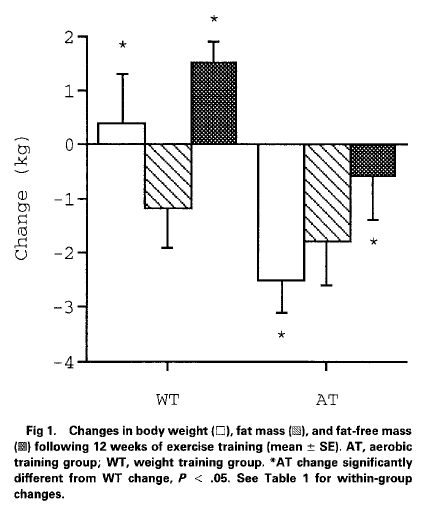
Following the weight loss period, the participants were randomly assigned to either a 12-week aerobic training (four men, five women) or weight training (four men, five women) exercise program. They exercised 3 days per week. These were whole-body workouts, with emphasis on compound (i.e., multiple-muscle) exercises. The figure below shows what actually happened with the participants.


As you can see, the strength training group (WT) gained about 1.5 kg of lean mass, lost 1.2 kg of fat, and thus gained some weight. The aerobic training group (AT) lost about 0.6 kg of lean mass and 1.8 kg of fat, and thus lost some weight.

Which group fared better? In terms of body composition changes, clearly the strength training group fared better. But my guess is that the participants in the strength training group did not like seeing their weight going up after losing a significant amount of weight through dieting. (An analysis of the possible psychological effects of this would be interesting; a discussion for another blog post.)

The changes in the aerobic training group were predictable, and were the result of compensatory adaptation. Their bodies changed to become better adapted to aerobic exercise, for which a lot of lean mass is a burden, as is a lot of fat mass.

So, essentially the participants in the strength training group lost fat and gained muscle at the same time. The authors say that the participants generally stuck with their weight-loss diet during the 12-week exercise period, but not a very strict away. It is reasonable to conclude that this induced a mild caloric deficit in the participants.

Exercise probably induced hunger, and possibly a caloric surplus on exercise days. If that happened, the caloric deficit must have occurred on non-exercise days. Without some caloric deficit there would not have been fat loss, as extra calories are stored as fat.

There are many self-help books and programs online whose main claim is to have a “revolutionary” prescription for concurrent fat loss and muscle gain – the “holy grail” of body composition change.

Well, it may be as simple as combining strength training with a mild caloric deficit, in the context of a nutritious diet focused on unprocessed foods.

Reference:

Ballor, D.L., Harvey-Berino, J.R., Ades, P.A., Cryan, J., & Calles-Escandon, J. (1996). Contrasting effects of resistance and aerobic training on body composition and metabolism after diet-induced weight loss. Metabolism, 45(2), 179-183.

Tuesday, August 31, 2010

How to become diabetic in 6 hours!? Thanks Dr. Delgado for bringing science to the masses!

(Note: My apologies for the sarcastic tone of this post. I am not really congratulating anybody here!)

Dr. Nick Delgado shows us in this YouTube video how to "become diabetic" in 6 hours!

I must admit that I liked the real-time microscope imaging, and wish he had shown us more of that.

But really!

After consulting with my mentor, the MIMIW, I was reminded that there is at least one post on this blog that shows how one can "become diabetic" in just over 60 minutes – that is, about 6 times faster than using the technique described by Dr. Delgado.

The technique used in the post mentioned above is called "intense exercise", which is even believed to be health-promoting! (Unlike drinking olive oil as if it was water, or eating white bread.)

The advantage of this technique is that one can "become diabetic" by doing something healthy!

Thanks Dr. Delgado, your video ranks high up there, together with this Ali G. video, as a fine example of how to bring real science to the masses.

Sunday, August 29, 2010

Heavy physical activity may significantly reduce heart disease deaths, especially after age 45

The idea that heavy physical activity is a main trigger of heart attacks is widespread. Often endurance running and cardio-type activities are singled out. Some people refer to this as “death by running”. Others think that strength training has a higher lethal potential. We know based on the Oregon Sudden Unexpected Death Study that this is a myth.

Here is some evidence that heavy physical activity in fact has a significant protective effect. The graph below, from Brooks et al. (2005) shows the number of deaths from coronary heart disease, organized by age group, in longshoremen (dock workers). The shaded bars represent those whose level of activity at work was considered heavy. The unshaded bars represent those whose level of activity at work was considered moderate or light (essentially below the “heavy” level).


The data is based on an old and classic study of 6351 men, aged 35 to 74 years, who were followed either for 22 years, or to death, or to the age of 75. It shows a significant protective effect of heavy activity, especially after age 45. The numbers atop the unshaded bars reflect the relative risk of death from coronary heart disease in each age group. For example, in the age group 65-74, the risk among those not in the heavy activity group is 110 percent higher (2.1 times higher) than in the heavy activity group.

It should be noted that this is a cumulative effect, of years of heavy activity. Based on the description of the types of activities performed, and the calories spent, I estimate that the heavy activity group performed the equivalent of a few hours of strength training per week, plus a lot of walking and other light physical activities. The authors of the study concluded that “… repeated bursts of high energy output established a plateau of protection against coronary mortality.

Heavy physical activity may not make you lose much weight, but has the potential to make you live longer.

Reference:

Brooks, G.A., Fahey, T.D., & Baldwin, K.M. (2005). Exercise physiology: Human bioenergetics and its applications. Boston, MA: McGraw-Hill.

Thursday, August 19, 2010

The theory of supercompensation: Strength training frequency and muscle gain

Moderate strength training has a number of health benefits, and is viewed by many as an important component of a natural lifestyle that approximates that of our Stone Age ancestors. It increases bone density, muscle mass, and improves a number of health markers. Done properly, it may decrease body fat percentage.

Generally one would expect some muscle gain as a result of strength training. Men seem to be keen on upper-body gains, while women appear to prefer lower-body gains. Yet, many people do strength training for years, and experience little or no muscle gain.

Paradoxically, those people experience major strength gains, both men and women, especially in the first few months after they start a strength training program. However, those gains are due primarily to neural adaptations, and come without any significant gain in muscle mass. This can be frustrating, especially for men. Most men are after some noticeable muscle gain as a result of strength training. (Whether that is healthy is another story, especially as one gets to extremes.)

After the initial adaptation period, of “beginner” gains, typically no strength gains occur without muscle gains.

The culprits for the lack of anabolic response are often believed to be low levels of circulating testosterone and other hormones that seem to interact with testosterone to promote muscle growth, such as growth hormone. This leads many to resort to anabolic steroids, which are drugs that mimic the effects of androgenic hormones, such as testosterone. These drugs usually increase muscle mass, but have a number of negative short-term and long-term side effects.

There seems to be a better, less harmful, solution to the lack of anabolic response. Through my research on compensatory adaptation I often noticed that, under the right circumstances, people would overcompensate for obstacles posed to them. Strength training is a form of obstacle, which should generate overcompensation under the right circumstances. From a biological perspective, one would expect a similar phenomenon; a natural solution to the lack of anabolic response.

This solution is predicted by a theory that also explains a lack of anabolic response to strength training, and that unfortunately does not get enough attention outside the academic research literature. It is the theory of supercompensation, which is discussed in some detail in several high-quality college textbooks on strength training. (Unlike popular self-help books, these textbooks summarize peer-reviewed academic research, and also provide the references that are summarized.) One example is the excellent book by Zatsiorsky & Kraemer (2006) on the science and practice of strength training.

The figure below, from Zatsiorsky & Kraemer (2006), shows what happens during and after a strength training session. The level of preparedness could be seen as the load in the session, which is proportional to: the number of exercise sets, the weight lifted (or resistance overcame) in each set, and the number of repetitions in each set. The restitution period is essentially the recovery period, which must include plenty of rest and proper nutrition.


Note that toward the end there is a sideways S-like curve with a first stretch above the horizontal line and another below the line. The first stretch is the supercompensation stretch; a window in time (e.g., a 20-hour period). The horizontal line represents the baseline load, which can be seen as the baseline strength of the individual prior to the exercise session. This is where things get tricky. If one exercises again within the supercompensation stretch, strength and muscle gains will likely happen. (Usually noticeable upper-body muscle gain happens in men, because of higher levels of testosterone and of other hormones that seem to interact with testosterone.) Exercising outside the supercompensation time window may lead to no gain, or even to some loss, of both strength and muscle.

Timing strength training sessions correctly can over time lead to significant gains in strength and muscle (see middle graph in the figure below, also from Zatsiorsky & Kraemer, 2006). For that to happen, one has not only to regularly “hit” the supercompensation time window, but also progressively increase load. This must happen for each muscle group. Strength and muscle gains will occur up to a point, a point of saturation, after which no further gains are possible. Men who reach that point will invariably look muscular, in a more or less “natural” way depending on supplements and other factors. Some people seem to gain strength and muscle very easily; they are often called mesomorphs. Others are hard gainers, sometimes referred to as endomorphs (who tend to be fatter) and ectomorphs (who tend to be skinnier).


It is not easy to identify the ideal recovery and supercompensation periods. They vary from person to person. They also vary depending on types of exercise, numbers of sets, and numbers of repetitions. Nutrition also plays a role, and so do rest and stress. From an evolutionary perspective, it would seem to make sense to work all major muscle groups on the same day, and then do the same workout after a certain recovery period. (Our Stone Age ancestors did not do isolation exercises, such as bicep curls.) But this will probably make you look more like a strong hunter-gatherer than a modern bodybuilder.

To identify the supercompensation time window, one could employ a trial-and-error approach, by trying to repeat the same workout after different recovery times. Based on the literature, it would make sense to start at the 48-hour period (one full day of rest between sessions), and then move back and forth from there. A sign that one is hitting the supercompensation time window is becoming a little stronger at each workout, by performing more repetitions with the same weight (e.g., 10, from 8 in the previous session). If that happens, the weight should be incrementally increased in successive sessions. Most studies suggest that the best range for muscle gain is that of 6 to 12 repetitions in each set, but without enough time under tension gains will prove elusive.

The discussion above is not aimed at professional bodybuilders. There are a number of factors that can influence strength and muscle gain other than supercompensation. (Still, supercompensation seems to be a “biggie”.) Things get trickier over time with trained athletes, as returns on effort get progressively smaller. Even natural bodybuilders appear to benefit from different strategies at different levels of proficiency. For example, changing the workouts on a regular basis seems to be a good idea, and there is a science to doing that properly. See the “Interesting links” area of this web site for several more focused resources of strength training.

Reference:

Zatsiorsky, V., & Kraemer, W.J. (2006). Science and practice of strength training. Champaign, IL: Human Kinetics.

Sunday, June 27, 2010

Exercise and blood glucose levels: Insulin and glucose responses to exercise

The notion that exercise reduces blood glucose levels is widespread. That notion is largely incorrect. Exercise appears to have a positive effect on insulin sensitivity in the long term, but also increases blood glucose levels in the short term. That is, exercise, while it is happening, leads to an increase in circulating blood glucose. In normoglycemic individuals, that increase is fairly small compared to the increase caused by consumption of carbohydrate-rich foods, particularly foods rich in refined carbohydrates and sugars.

The figure below, from the excellent book by Wilmore and colleagues (2007), shows the variation of blood insulin and glucose in response to an endurance exercise session. The exercise session’s intensity was at 65 to 70 percent of the individuals’ maximal capacity (i.e., their VO2 max). The session lasted 180 minutes, or 3 hours. The full reference to the book by Wilmore and colleagues is at the end of this post.


As you can see, blood insulin levels decreased markedly in response to the exercise bout, in an exponential decay fashion. Blood glucose increased quickly, from about 5.1 mmol/l (91.8 mg/dl) to 5.4 mmol/l (97.2 mg/dl), before dropping again. Note that blood glucose levels remained somewhat elevated throughout the exercise session. But, still, the elevation was fairly small in the participants, which were all normoglycemic. A couple of bagels would easily induce a rise to 160 mg/dl in about 45 minutes in those individuals, and a much larger “area under the curve” glucose response than exercise.

So what is going on here? Shouldn’t glucose levels go down, since muscle is using glucose for energy?

No, because the human body is much more “concerned” with keeping blood glucose levels high enough to support those cells that absolutely need glucose, such as brain and red blood cells. During exercise, the brain will derive part of its energy from ketones, but will still need glucose to function properly. In fact, that need is critical for survival, and may be seen as a bit of an evolutionary flaw. Hypoglycemia, if maintained for too long, will lead to seizures, coma, and death.

Muscle tissue will increase its uptake of free fatty acids and ketones during exercise, to spare glucose for the brain. And muscle tissue will also consume glucose, in part for glycogenesis; that is, for making muscle glycogen, which is being depleted by exercise. In this sense, we can say that muscle tissue is becoming somewhat insulin resistant, because it is using more free fatty acids and ketones for energy, and thus less glucose. Another way of looking at this, however, which is favored by Wilmore and colleagues (2007), is that muscle tissue is becoming more insulin sensitive, because it is still taking up glucose, even though insulin levels are dropping.

Truth be told, the discussion in the paragraph above is mostly academic, because muscle tissue can take up glucose without insulin. Insulin is a hormone that allows the pancreas, its secreting organ, to communicate with two main organs – the liver and body fat. (Yes, body fat can be seen as an “organ”, since it has a number of endocrine functions.) Insulin signals to the liver that it is time to take up blood glucose and either make glycogen (to be stored in the liver) or fat with it (secreting that fat in VLDL particles). Insulin signals to body fat that it is time to take up blood glucose and fat (e.g., packaged in chylomicrons) and make more body fat with it. Low insulin levels, during exercise, will do the opposite, leading to low glucose uptake by the liver and an increase in body fat catabolism.

Resistance exercise (e.g., weight training) induces much higher glucose levels than endurance exercise; and this happens even when one has fasted for 20 hours before the exercise session. The reason is that resistance exercise leads to the conversion of muscle glycogen into energy, releasing lactate in the process. Lactate is in turn used by muscle tissues as a source of energy, helping spare glycogen. It is also used by the liver for production of glucose through gluconeogenesis, which significantly elevates blood glucose levels. That hepatic glucose is then used by muscle tissues to replenish their depleted glycogen stores. This is known as the Cori cycle.

Exercise seems to lead, in the long term, to insulin sensitivity; but through a fairly complex and longitudinal process that involves the interaction of many hormones. One of the mechanisms may be an overall reduction in insulin levels, leading to increased insulin sensitivity as a compensatory adaptation. In the short term, particularly while it is being conducted, exercise nearly always increases blood glucose levels. Even in the first few months after the beginning of an exercise program, blood glucose levels may increase. If a person who was on a low carbohydrate diet started a 3-month exercise program, it is quite possible that the person’s average blood glucose would go up a bit. If low carbohydrate dieting began together with the exercise program, then average blood glucose might drop significantly, because of the acute effect of this type of dieting on average blood glucose.

Still exercise is health-promoting. The combination of the long- and short-term effects of exercise appears to lead to an overall slowing down of the progression of insulin resistance with age. This is a good thing.

Reference:

Wilmore, J.H., Costill, D.L., & Kenney, W.L. (2007). Physiology of sport and exercise. Champaign, IL: Human Kinetics.

Tuesday, June 15, 2010

Soccer as play and exercise: Resistance and endurance training at the same time

Many sports combine three key elements that make them excellent fitness choices: play, resistance exercise, and endurance exercise; all at the same time. Soccer is one of those sports. Its popularity is growing, even in the US! The 2010 FIFA World Cup, currently under way in South Africa, is a testament to that. It helps that the US team qualified and did well in its first game against England.

Pelé is almost 70 years old in the photo below, from Wikipedia. He is widely regarded as the greatest soccer player of all time. But not by Argentineans, who will tell you that Pelé is probably the second greatest soccer player of all time, after Maradona.


Even though Brazil is not a monarchy, Pelé is known there as simply “The King”. How serious are Brazilians about this? Well, consider this. Fernando Henrique Cardoso was one of the most popular presidents of Brazil. He was very smart; he appointed Pelé to his cabinet. But when Cardoso had a disagreement with Pelé he was broadly chastised in Brazil for disrespecting “The King”, and was forced to publicly apologize or blow his political career!

Arguably soccer is a very good choice of play activity to be used in combination with resistance exercise. When used alone it is likely to lead to much more lower- than upper-body muscle development. Unlike before the 1970s, most soccer players today use whole body resistance exercise as part of their training. Still, you often see very developed leg muscles and relatively slim upper bodies.

What leads to leg muscle gain are the sprints. Interestingly, it is the eccentric part of the sprints that add the most muscle, by causing the most muscle damage. That is, it not the acceleration, but the deceleration phase that leads to the largest gains in leg muscle.

This eccentric phase effect is true for virtually all types of anaerobic exercise, and a well known fact among bodybuilders and exercise physiologists (see, e.g., Wilmore et al., 2007; full reference at the end of the post). For example, it is not the lifting, but the lowering of the bar in the chest press, which leads to the most muscle gain.

Like many sports practiced at high levels of competition, professional soccer can lead to serious injuries. So can non-professional, but highly competitive play. Common areas of injury are the ankles and the knees. See Mandelbaum & Putukian (1999) for a discussion of possible types of health problems associated with soccer; it focuses on females, but is broad enough to serve as a general reference. The full reference and link to the article are given below.

References:

Mandelbaum, B.R., & Putukian, M. (1999). Medical concerns and specificities in female soccer players. Science & Sports, 14(5), 254-260.

Wilmore, J.H., Costill, D.L., & Kenney, W.L. (2007). Physiology of sport and exercise. Champaign, IL: Human Kinetics.

Monday, June 7, 2010

Niacin turbocharges the growth hormone response to anaerobic exercise: A delayed effect

Niacin is also known as vitamin B3, or nicotinic acid. It is an essential vitamin whose deficiency leads to pellagra. In large doses of 1 to 3 g per day it has several effects on blood lipids, including an increase in HDL cholesterol and a marked decreased in fasting triglycerides. Niacin is also a powerful antioxidant.

Among niacin’s other effects, when taken in large doses of 1 to 3 g per day, is an acute elevation in growth hormone secretion. This is a delayed effect, frequently occurring 3 to 5 hours after taking niacin. This effect is independent of exercise.

It is important to note that large doses of 1 to 3 g of niacin are completely unnatural, and cannot be achieved by eating foods rich in niacin. For example, one would have to eat a toxic amount of beef liver (e.g., 15 lbs) to get even close to 1 g of niacin. Beef liver is one of the richest natural sources of niacin.

Unless we find out something completely unexpected about the diet of our Paleolithic ancestors in the future, we can safely assume that they never benefited from the niacin effects discussed in this post.

With that caveat, let us look at yet another study on niacin and its effect on growth hormone. Stokes and colleagues (2008) conducted a study suggesting that, in addition to the above mentioned beneficial effects of niacin, there is another exercise-induced effect: niacin “turbocharges” the growth hormone response to anaerobic exercise. The full reference to the study is at the end of this post. Figure 3, shown below, illustrates the effect and its magnitude. Click on it to enlarge.


The closed diamond symbols represent the treatment group. In it, participants ingested a total of 2 g of niacin in three doses: 1 g ingested at 0 min, 0.5 g at 120 min, and 0.5 g at 240 min. The control group ingested no niacin, and is represented by the open square symbols. (The researchers did not use a placebo in the control group; they justified this decision by noting that the niacin flush nullified the benefits of using a placebo.) The arrows indicate points at which all-out 30-second cycle ergometer sprints occurred.

Ignore the lines showing the serum growth hormone levels in between 120 and 300 min; they were not measured within that period.

As you can see, the peak growth hormone response to the first sprint was almost two times higher in the niacin group. In the second sprint, at 300 min, the rise in growth hormone is about 5 times higher in the niacin group.

We know that growth hormone secretion may rise 300 percent with exercise, without niacin. According to this study, this effect may be “turbocharged” up to a 600 percent rise with niacin within 300 min (5 h) of taking it, and possibly 1,500 percent soon after 300 min passed since taking niacin.

That is, not only does niacin boost growth hormone secretion anytime after it is taken, but one still gets the major niacin increase in growth hormone at around 300 min of taking it (which is about the same, whether you exercise or not). Its secretion level at this point is, by the way, higher than its highest level typically reached during deep sleep.

Let me emphasize that the peak growth hormone level achieved in the second sprint is about the same you would get without exercise, namely a bit more than 20 micrograms per liter, as long as you took niacin (see Quabbe's articles at the end of this post).

Still, if you time your exercise session to about 300 min after taking niacin you may have some extra benefits, because getting that peak growth hormone secretion at the time you are exercising may help boost some of the benefits of exercise.

For example, the excess growth hormone secretion may reduce muscle catabolism and increase muscle anabolism, at the same time, leading to an increase in muscle gain. However, there is evidence that growth hormone-induced muscle gain occurs only when testosterone levels are elevated. This explains why growth hormone levels are usually higher in young women than young men, and yet young women do not put on much muscle in response to exercise.

Reference:

Stokes, K.A., Tyler, C., & Gilbert, K.L. (2008). The growth hormone response to repeated bouts of sprint exercise with and without suppression of lipolysis in men. Journal of Applied Physiology, 104(3), 724-728.