Showing posts with label yoga sutras. Show all posts

Wednesday, October 16, 2013

Pratyahara and Healthy Aging

by Ram
Fern by Melina Meza
In the Yoga Sutras by Patanjali we are introduced to the eight rungs/limbs/steps of yoga whose practice helps us to develop attention as a tool to discriminate between ignorance and awareness and between truth and illusion, which is the means for liberation or enlightenment. Pratyahara is rung five of the eight rungs. Verse 2.54 in the Yoga Sutras describes Pratyahara as:

sva vishaya asamprayoge chittasya svarupe anukarah iva indriyanam pratyaharah

When the mental organs of senses and actions (indriyas) cease to be engaged with the corresponding objects in their mental realm, and assimilate or turn back into the mind-field from which they arose, this is called pratyahara. —trans. by Swami Jnaneshvara.


Check any commentary or text on this topic and the term “pratyahara” would be defined as “withdrawal of senses.” However, the concept of withdrawal of senses may be difficult to comprehend for I have witnessed a few teachers in some of the yoga teacher’s training gently brushing off this topic. During the course of her blog interview with Nina and Shari when asked about how she adapted her yoga practice through peri-menopause and menopause, Judith Laster remarked, “As I entered peri-menopause, I noticed a definite shift of my interest. It was as if a natural pratyahara was taking place.” Ever wondered what Judith meant by that statement?

Personally speaking, “withdrawal of senses” does not appeal to me. In this present world, staying with a family, raising kids and paying college tuitions, doing our jobs and facing challenges at work, etc. all require the coordinated usage of the five senses. One cannot withdraw the senses from our daily life’s duties unless we give up on everything and retire to the mountains. So I like to define pratyahara as “using our senses with total/complete awareness.” Our five senses serve as portals or gateways into our body, mind and consciousness. We are what we eat, smell, see, hear and touch. It is through these senses that we absorb the world around us. If we take in harmonious impressions through our senses, we will in turn be healthier. If we take in that which is unhealthy, the mind and body suffers. If we are not aware about what we draw in through our senses, it can lead to physical and mental instability. The human body and mind can survive on low-quality sensory impressions but it cannot thrive. In order to maximize life potential, each person must learn to live harmoniously with their environment through the five senses.

Most of us are familiar with one of the main tenets of the Yoga philosophy:

Yogas chitta vritii nirodhah
[yoga =union, to join; chitta = mutable thoughts of the mind-field; vritti = mental fluctuations/modifications, nirodhah = coordination, regulation, integration, channeling]

Yoga is the coordinated channeling of the gross and subtle thought patterns of the mind. —trans. by Swami Jnaneshvara

A human being as a whole is a combination of body, mind and spirit—physical, mental (psychological) and spiritual dimension. When we just think of ourselves as a physical body, we lose this awareness and through our five senses we get attracted to material possessions and surround ourselves with them. As we continue to build more material desires, we start making wrong choices. As a result, frustration and stress builds up and we lose our connection with the mind and spirit. This leads to mental imbalance/fluctuations (vrittis) leading to physical instability. Healing is the process of regulating the impressions that we draw in with total awareness through the five senses and returning to harmony. Once back in harmony, the body and the mind have no reason to communicate the imbalances. It is only through experience and awareness that we gradually awaken to the true role of our senses. Enlightenment is when we have a control over our senses and perform only those activities that not only empower us but the society as well. Such beneficial activities do not disturb the natural balance of the body or the society. The body is at ease; the mind attains peace.

Wednesday, October 9, 2013

Non-Holding (Aparigrapha)

by Nina

"Holding on to one's thoughts is also a form of possessiveness…." BKS Iyengar
Untitled Drawing by Milton Zolotow, one of hundreds
Ram's recent post on aparigrapha (non-hoarding) left a strong impression on me. In it, he mentioned several meanings for aparigrapha, including "non-possessiveness, non-holding, non-indulgence, non-acquistiveness." Recently I've been thinking a lot about the "non-holding" aspect of aparigrapha.

Non-holding has been on my mind because I've started to feel weighed down with possessions. That's partly because in the last few years, both my parents and Brad's parents died, and we ended up with a lot of their stuff. Some of the things were useful, like the beautiful dining room table we inherited from my parents. We are using that table now and gave our old table to our daughter who started her own household, so a kind of balance has been established. A lot of the other stuff isn't at all "useful" but still has a tremendous emotional power over me. For example, we inherited a couple of boxes of samples of my father's graphic design work, scrapbooks that Brad's mother created during the high school, college and the early years of her marriage, and some of my chic mother's favorite clothes that I'll never wear because they don't fit. It has been surprisingly hard to even consider getting rid of these things, and yet….

This is on my mind today because I just got back from a trip where I visited two longtime friends, each of whom happened to be in the same position, having things, either in her house or in a storage facility, that there was no real use for but to which she had strong emotional attachments. We all agreed that it was material we would need to part with at some point, and yet we all shared that it was surprisingly painful to even consider doing.

About a year ago, I started a practice of getting rid of at least one thing every day. I kept it up for a few months—in the beginning it was easy because every time I opened a cabinet I saw something of my own that I really didn't need—but then it became harder and harder. I would open a box of my parent's stuff, feel overwhelmed with emotion, and then close it up again. And I eventually gave up the daily practice. There's something about fall for me, though, that feels like the time to get back to business. My conversations with those two friends this weekend motivated me even more. So I returned from my summer vacation and decided to resume my getting-rid-of-one-thing-a-day practice. Today I went back and read Ram's post and a bit of the Yoga Sutras. This time I was struck by concept of "non-holding" as being about not holding on to thoughts (as Iyengar wrote) and emotions (as Ram wrote). Of course, with our parents' things that we three women are holding on to, it is not the objects themselves that we are having such a hard time letting go of, but rather the thoughts and emotions that the objects evoke.

I feel that this new understanding of "non-holding" will help make it easier for me to keep up with my letting-go practice this year and start to move from the easy tasks to the harder ones.

Tuesday, September 3, 2013

Aparigraha (Non-Hoarding) and Healthy Aging

by Ram
Naushon Tree by Brad Gibson
In the Sadhana Pada of the Yoga Sutras by Patanjali we are introduced to the eight rungs/limbs/steps of yoga whose practice helps us to develop attention as a tool to discriminate between ignorance and awareness and truth from illusion, the means for liberation or enlightenment. One of the eight limbs is aparigraha, which has several meanings, including non-possessiveness, non-holding, non-indulgence, non-acquisitiveness. Verse 2.39 in the Yoga Sutras describes aparigraha as:

aparigraha sthairye janma kathanta sambodhah

When one is steadfast in non-possessiveness or non-grasping with the senses there arises knowledge of the why and wherefore of past and future lives. —trans. by Swami Jnaneshvara


 Aparigraha comes from the word parigraha, which means reaching out for something and claiming it for oneself; the "a" prefix' before parigraha turns it into an antonym. Thus, aparigraha is the concept of non-possessiveness or non-hoarding. Aparigraha means to limit possessions to what is necessary or important and taking what is truly necessary and no more. Nina briefly touched on this topic in one of her earlier postings (see Yama Drama).

Our senses are like portals or gateways into our body, mind and consciousness. We are what we eat, smell, see, hear and touch. Through our senses, we absorb the world around us. If we take in harmonious impressions, we will in turn be healthier. If we absorb disharmonious impressions through our senses, we are inviting with it all kinds of body-mind problems. Through these five senses we get attracted to material possessions and surround ourselves with them. Hoarding is the accumulation of things that may have little or no value. So great is the need to accumulate these things that they then becomes difficult to part with it. Hoarders accumulate and store old newspapers, food cartons, cans, mail, notes, clothes, garbage and other debris. Hoarding begins slowly and builds over time. Hoarders will not give up their possessions as they develop an emotional attachment to their belongings and have a distorted view about the importance/lack of importance of material possessions. People who develop a habit of hoarding identify their possessions as a part of their identities. Losing or disposing of a possession may produce extreme anxiety or a sense of loss and grief. Researchers believe that individuals who are experiencing emotional upheavals in their lives when faced with aging and the possibility of outliving their resources may begin to collect and save as these material possessions provides them a sense of security—sort of a comfort zone.

But hoarding is not just about accumulating material possessions. It is also about hoarding/holding thoughts and emotions that affect our normal mindset and thinking process. Hoarding, be it mental or physical, is associated with an inability to process information and make decisions when confronted with a large amount of information, attention and focus deficits and a failure of categorization. We tend to fill our minds with fear, worry, anxiety, grief, anger, rage, jealousy, and judgments, among others, and we do not let go of these emotions. Over time, these emotions—whether it be bitterness, fear, emotional damage, rejection or abandonment—build up. If you hoard/accumulate unexpressed or suppressed emotions and if they are not getting released, they keep building up in your body. Ultimately these pent-up emotions can trigger mental and/or physical pathological conditions. Thus, hoarding emotions can be devastating to both mind and body.

What is the easiest and effective way to ward off emotional hoarding? A simple method is meditation (dhyana), the cheapest and simplest recourse to a healthy body and mind (see Balancing Your Emotions with Your Breath). While meditation may not cure a person from the act of hoarding, the person having a meditation practice will react to life’s turbulence differently. This reaction and suitable action measures comes from a true awareness; awareness to the emotional turbulence arising from within that has remedial effects. As explained in an earlier post (see Never Go to Bed Angry), the individual will not only have the capacity to transcend the physical and emotional upheaval but will also not evoke the same physical and emotional reactions that are commonly seen in a person who does not meditate.

Just as you take a car for a regular tune up, you also need to detoxify and tune up our body and mind on a periodical basis. Disposing of any unwanted material possessions and detoxifying our mind-riddled emotions on a regular basis is a panacea for healthy aging and living. If you can do it for your car, you might as well think about doing the same for your mind and body.

Wednesday, August 28, 2013

Take Your Time: Results from Yoga Practice

by Nina

Horses Grazing by Brad Gibson
It's a running joke in our family that when Brad gets impatient with me—because I often do various household tasks a bit slower than he does—he says to me, "Take your time!" He swears that Bill Murray said this repeatedly in the movie Caddy Shack, but when we watched it again recently, no one actually ever uttered that line. Regardless, I always reply, "You take your time."

But many worthwhile things really do take time. For example, if you want to cook a really good meal instead of eating fast food, you need to shop for fresh ingredients and prepare everything from scratch. And if you want to turn a new acquaintance into a close friend, you need to spend a lot of time together, getting to know and trust each other. The same is true for seeing results from yoga practice. Obviously, one Downward-Facing Dog pose doesn't instantly make your arms stronger, though with regular practice, it definitely will increase your strength. And it also seems obvious that if you want to reduce your stress levels, you'll need to practice stress management regularly over a period of time.

So it was very interesting for me to hear about a recent study at the Feinberg School of Medicine, Northwestern University, that looked at the effect of exercise on insomnia. One of the findings as reported by Gretchen Reynolds in the New York Times post How Exercise Can Help Us Sleep Better was:

"After the first two months of their exercise program, the exercising volunteers (all of them women) were sleeping no better than at the start of the study. Only after four months of the program had their insomnia improved."


Yes, it took four whole months of regular exercising to bring improvements. That's quite a bit of time, don't you think? The women in this study were not practicing yoga for exercise, but it's likely that using yoga as a form of exercise to help with insomnia (something I definitely recommend) might take a similar amount of time. And it also makes sense to me that if you are practicing yoga for insomnia (see Yoga for Insomnia, Part 1) by using stress management techniques, you should also give that some time (though some people report that doing breath practices in the middle of the night produces immediate results). So be patient.

In general, the time you invest in your yoga practice—whether you are practicing for your physical health, your emotional health or both—is what brings the payoffs. After all, yoga sutra 1.14 tells us that equanimity is attained only through steady, dedicated, attentive practice:

Long, uninterrupted, alert practice is the firm foundation for restraining the fluctuations of the mind. —trans. by B.K.S. Iyengar

Thursday, August 8, 2013

Practicing with Pain

by Nina
Needle and Ice by Melina Meza
When a man has mastered himself,
he is perfectly at ease in cold,
in heat, in pleasure or pain,
in honor or disgrace

Bhagavad Gita, trans. by Stephen Mitchell

We get many comments on our blog, but every once in a while there is one that makes me feel sad, like this one, which one of our readers left on a post about menopause:

This will certainly be relevant for me (65). Besides ongoing extreme irritability, yoga is not the joy it has always been for me because of joint stiffness and pain. What little stability I felt in life came from yoga, and feel that slipping away when I need it most.

My first reaction to this was to write to Shari and suggest that she write about menopause and joint pain because I knew that she, too, was currently suffering from joint problems (see Yoga for Menopause: Joint Problems). But even after ensuring that this topic was going to be addressed, I was concerned about the underlying issue:

yoga is not the joy it has always been 

what stability in life that came from yoga is slipping away


The thing is, I don't believe that physical pain means that yoga practice needs to be less joyful, or that the stability that practice brings will slip away if your asanas hurt more than they used to. And I speak from experience. Now that I'm over two bouts of frozen shoulder (which, trust me, were very painful), I'm still living with an arthritic hip that's not going to go away. So for many years, I've experienced pain when I practice asana at home or during a class. And, of course, I definitely cannot practice many of the poses I used to do on a regular basis. However, practicing yoga is still a positive, life-affirming experience for me, and as joyful as it ever was.

Because, after all, what is yoga? Definitions of yoga in the scriptures vary from "yoga is equanimity" to "yoga is cessation of the fluctuations of the mind" but nowhere is there anything about practicing pain-free asana. Indeed, as the quote at the beginning of the post tells us, being a yogi means being equally at ease in pain as in pleasure.

Both Ram and I have written about cultivating santosha as an important part of yoga practice (see Santosha: Happiness and Longevity  and Yoga and the Pursuit of Happiness ). Santosha means "contentment" and TKV Desikachar defines contentment as "the ability to be comfortable with what we have and what we do not have." And I believe that being comfortable with what we have and what we do not have must include practicing asana while in physical pain and being comfortable with that. And as for the joy, the Yoga Sutras tells us in sutra 2.42 "Perfect happiness is attained through contentment."

So the path back to joy is not through the elimination of pain, but rather through cultivating contentment. In his post Achieving Stillness in Turbulent Situations Ram told us how his grandfather taught him to meditate in a train station in India because achieving stillness in a noisy, chaotic environment was what the practice of meditation was all about. Likewise, I feel that learning how to find contentment in our asana practice, even while in physical pain, is also the essence of yoga. (Of course, you should continue to use pain as a guide to practicing safely as Shari describes in her post Yoga for Menopause: Joint Problems.)

So dear commenter and all our other readers, while I hope you may find some helpful hints on this blog that will help reduce your physical pain, we cannot remove all pain from your life  But we can offer you something more valuable. For practicing yoga by cultivating santosha inside and outside the yoga room will help see you through life's challenges in whatever form they take. As I wrote in my post Yoga and the Pursuit of Happiness, the Yoga Sutras make it clear which steps to take on that journey:

1.12 Practice and detachment are the means to still the movements of consciousness.

1.33 Through cultivation of friendliness, compassion, joy, and indifference to pleasure and pain, virtue and vice respectively, the consciousness becomes favorably disposed, serene and benevolent.

1.34 Or, by maintaining the pensive state felt at the time of soft and steady exhalation and during passive retention after exhalation.

1.35 Or, by contemplating an object that helps to maintain steadiness of mind and consciousness. 

Wednesday, May 22, 2013

The Dangers of Being Sedentary: Styana, Alasya, and Yoga

by Ram

Dance by Marc Chagall

Yoga and Ayurveda are sister sciences, with Ayurveda being the healing side of Yoga, and Yoga serving as the spiritual side of Ayurveda. Through the practices of Ayurveda and Yoga an individual is able to connect to his/her true nature through direct experience, and live a meaningful and purposeful life. This would mean following stable routines, having a balanced and nourishing timely diet (see You Are When You Eat) and adapting the eight fold yogic path (ashtanga yoga). However, there are a number of obstacles that arise on the journey to a meaningful life that can prove to be a challenge. In the Yoga Sutras of Patanjali, verses 1.30-1.32 describe several distractions that serve as obstacles on the journey toward perfect health and enlightenment. 

vyadhi styana samshaya pramada alasya
avirati bhranti-darshana alabdha-bhumikatva
anavasthitatva chitta vikshepa te antarayah


“Nine kinds of distractions that are obstacles naturally encountered on the path are physical illness, tendency of the mind to not work efficiently, doubt or indecision, lack of attention to pursuing the means of samadhi, laziness in mind and body, failure to regulate the desire for worldly objects, incorrect assumptions or thinking, failing to attain stages of the practice, and instability in maintaining a level of practice once attained.”—translation by Swami Jnaneshvara

Sitting for more than three hours, sleeping for extended periods of time, watching long hours of TV or simply idling away the time would qualify as “styana” (inefficiency, idleness, procrastination, dullness) and “alasya” (laziness, sloth), which are now thought to be responsible for decreasing life expectancy in the United States. While technology may have increased our productivity, it has certainly made us lazier. Sitting for long periods, sleeping for more than the required hours and watching TV are the most common activities performed by indolent individuals. That puts these activities up there with smoking as a possible barrier to increasing life expectancy.

Findings from a recent study showed that individuals who sat for more than 11 hours daily were 40 percent more likely to die within the next three years than those who sat for four hours or less daily—even when people’s physical activity at other times of the day was accounted for. Studies have also indicated that sitting daily for less than 3 hours and watching TV for less than 2 hours extends life expectancy by an estimated 1 to 2 years. Studies reported in the prestigious journals Lancet and the British Medical Journal suggest that a sedentary lifestyle is the cause of one in 10 deaths worldwide. It’s now known that Americans are working less (26 minutes a day less compared to Y2007) and idling off more. Adults in the U.S. spend an average of 55 percent of their day engaged in some kind of sedentary behavior (see Sedentary behaviour and life expectancy in the USA: a cause-deleted life table analysis).

Data gathered from 33 countries indicate that sedentary lifestyle accounts for six percent of all cases of coronary heart disease, about 7 percent of type 2 diabetes and 10 percent of breast and colon cancers. The findings also suggested that if only 10 percent of those who are currently inactive started to exercise, 533,000 lives would be saved; if 25 percent began moving, 1.3 million deaths could be averted. Studies have also shown that even children are spending more time sitting at home than playing outdoors. Health experts are unanimous in their opinion that an adult requires at least 30 minutes/day of physical activity to stay fit while children require at least 60 minutes of playtime.

The Dance by Marc Chagall
Thus, there is no doubt that excessive time spent in sedentary behavior is not only having an impact on public health but also has effects on the life span of the individual. Those who maintain a reasonable amount of activity, particularly across the middle and later years, are twice as likely to avoid early death and serious illness. So take my advice, get off the couch and go to the nearest yoga studio for a yoga asana session or seek some enjoyable activity that involves a lot of movement. However, let me also remind our readers that physical activity need not be yoga asanas alone and neither does it have to be strenuous to achieve health benefits. The US Centers for Disease for Control and Prevention (CDC) recommend the following that constitutes physical activity: walking stairs (instead of taking the elevator), gardening, raking leaves, dancing, walking to different stores in the mall while shopping, carrying a grocery basket rather than pushing a cart (when applicable), parking in the farthest parking spot and walking to the office or store.

People of all ages benefit from doing any one or some or all of the above mentioned daily physical activities. Sedentary people need to start with short sessions (about 10 minutes) and gradually build up to the desired level of physical activity. It appears that it is never too late to make some changes and experience these positive outcomes. The antidote for these obstacles and their consequences are awareness, focus and determination (see Thoughts On Dhyana). Cultivating these qualities can prevent us from getting entangled and lost in the mire of delusion that can come from the above-mentioned obstacles (see Achieving Stillness in Turbulent Situations).

Note from Nina:
Ram recommends getting off the couch and going to a yoga studio for an asana session, but there is no reason you can’t simply get off the couch and do a little bit of yoga, right next to the couch (or anywhere else in your house). We’ve got lots of mini practices on our blog (look on our index for the three “mini” entries) that you can do, try a practice you find in a yoga book or DVD, or just start out with a Reclined Leg Stretch or a Downward-Facing Dog pose and see what happens next. If you skip just one TV program, you can do a half an hour of yoga without even leaving the house. I started my home yoga practice when I was working full time at a software startup company and co-parenting two young children, so I know you can do this! And, of course, if you’ve been following our office yoga series, you’ll know that we’ve got yoga poses you can do at work, at the airport, or anywhere else you can’t roll out a yoga mat (look on our index for the “office yoga” tag).

Monday, May 6, 2013

Ahimsa (Non-Violence) and Healthy Aging

by Ram 
Peaceful Valley by Brad Gibson
Himsa in Sanskrit means violence, which is defined as the intentional use of force or power on self or against a person or a group that results in a physical/psychological harm, mental disturbance, injury or death. Going by this definition, there is no difference between a person who is harboring severe judgment and negativity towards self or others and a person who walks with a gun into a classroom and randomly shoots at the students. Both have committed himsa or violence albeit to different degrees. We have also have heard or witnessed acts of himsa perpetrated in yoga studios as well.

Violence of any kind has profound effects on the health of an individual. Studies have shown the following:
  • The stress of being in an abusive relationship has the obvious physical and psychological impact: it often increases one’s vulnerability to illness and may cause the victim to be more susceptible to disease.
  • Battered victims experience depression, feelings of low self-esteem and helplessness coupled with somatic complaints.
  • Chronic abuse causes serious psychological harm. Victims experience panic disorders, phobias, anxieties and depression that may last for several years. Their ability to trust and form emotional attachments are severely impacted.
  • Victims often complain of enduring the effects of violence over many years and some even develop extreme symptoms years later in response to major life stressors.
Moreover violence severely impacts healthy aging and life expectancy is reduced in traumatic individuals. Recent studies have shown that the United States suffers far more violent deaths than any other wealthy nation. The United States has about six violent deaths per 100,000 residents. Homicide and suicide together account for about a quarter of the years of life lost for U.S. men compared to those in those peer countries. Children who are exposed to different types of violent childhood events suffer from all kinds of stressors that negatively affect their overall development. A ten-year study finds that a traumatic childhood reduces life expectancy by 20 years among adults who experienced six or more particular types of abuse or household dysfunction as kids. Thus, violence in all forms is taking its toll on the life expectancy of the U.S. population. The solution to this grave problem is shunning violence and cultivating ahimsa (non violence), the opposite of himsa. Ahimsa— which also refers to non-harming or non-injury—is the first of the five yamas in the yoga sutras of Patanjali. The five yamas serve as moral, ethical and societal guidelines for a harmonious living. Patanjali considered the yamas as universal vows, and preached that they be practiced on all levels: by way of thoughts, actions, and words. Verse 2.3 in the Yoga Sutras describes ahimsa as:

ahimsa pratishthayam tat vaira-tyagah

As a Yogi becomes firmly grounded in non-injury (ahimsa), other people who come near will naturally lose any feelings of hostility
trans. by Swami Jnaneshvara.

Going by the above translation, ahimsa would mean physical, mental, and emotional non-violence towards self and others. For those who are always in contact with individuals who experience natural inner peace and a non-harming attitude, there is a tendency for them to give up their hostilities, ill will or aggression in return. It is a natural process that everyone experiences in the presence of a truly non-violent person.

How does one cultivate ahimsa? Empathy and compassion are two excellent tools to foster ahimsa as they allow us to accept events as they are and act with an open and loving heart. Empathy and compassion replace violent tendencies with kindness, acceptance and love. Practicing it on oneself helps to cultivate the same feelings towards others. So how about cultivating some ahimsa in our lives starting now!

Kindly and non-violently,

Ram

Thursday, April 25, 2013

Practicing Yoga Off the Mat

by Nina 
Rock Close Up by Brad Gibson
This sutra prescribes a kind of mindfulness or mental cultivation off the mat, so to speak, that is, in day-to-day affairs outside of the context of citta-vritti-nirodha-type meditation. Cultivating the higher qualities of sattva is a continuous and constant requirement of the yogic path and spills over into all aspects of life’s affairs and social interactions. It speaks to the fact that yoga need not be perceived as a world-renouncing tradition but is perfectly compatible with engaged and benevolent social action in the world. —Edwin Bryant

In my home practice, I’ve worked on some pretty challenging yoga poses in my day (dropping from headstand into a backbend, for example), but the most challenging yoga practice I’ve ever attempted is something I’ve taken up lately, off the mat. In fact, it’s the practice recommended by the yoga sutra that Edwin Bryant was referring to in the above quote:

Yoga Sutra 1.33. By cultivating an attitude of friendship toward those who are happy, compassion toward those in distress, joy toward those who are virtuous, and equanimity toward those who are nonvirtuous, lucidity arises in the mind. —trans. by Edwin Bryant

In classical yoga, the intent of this practice is for cultivating the peace of mind (“lucidity arises in the mind”) that is a necessary prerequisite for achieving the union with the divine that is yoga. However, I’m adopting this practice (or trying to, anyway) for other reasons as well. One of my main reasons is to help me maintain good relationships as I age. (I want the richness of life that comes with that, not just the health benefits....)

In talking with some of my older friends, I’ve been noticing that many of them seem to be getting fed up with each other. They talk about this one being angry all the time or that one being lonely due to his or her own bad behavior in the past. And I can’t help but feel a little more compassion might go a long way to preserving these long-time friendships. It’s something Brad and I have been discussing, and we have agreed to try to cultivate more compassion for those in distress (as well as all that other stuff in the sutra 1.33) for the benefit of all our relationships in the long run.

I have to confess practice is very difficult for me, however. I tend to very judgmental, probably because that’s how I was raised. My parents were very snobbish—although that’s a word they wouldn’t use themselves—about people who didn’t share their values and tastes. I wonder now if that was a result of them both being the children of immigrants, and the hard times they had as children fitting in to the American mainstream. It’s not the stereotypical story—they were artistic types who taught me to disdain people who had a lot of money but no taste—but it’s still a story of people who used their judgments of others as a shield for their feelings of insecurity. I also tend to be very envious of other people’s successes (rather than happy for them). I don’t know if this was also a family pattern—I do know my father suffered from feelings of failure because he never lived up the expectations that he and others had for him when he was a young art prodigy—but it’s something I’ve observed about myself time and time again. And all these samskaras  (thought patterns) run very deep.

So how am I beginning my practice of this challenging form of yoga? For now, I’m starting with mindfulness in my thoughts and feelings about others. And when I catch myself moving toward (or leaping to) judgment, I remind myself that there is another attitude I can take: compassion. As Stephen Cope says in Yoga and the Quest for the True Self:

I have said that samskaras are like ruts in a road, and that as the ruts deepen through repetition, it becomes inevitable that the car will slide into them unawares. Any intentional effort to restrain the car from slipping into the rut is called tapas.

Tapas requires a particular kind of attention—precisely the kind required when driving on a rutted road. We need to be awake. We need to be concentrated in order to avoid the edges of the ruts. And sometimes we need to pull the car wheels—with considerable effort—out of the ridges in the road.

Monday, April 22, 2013

Satya: The Truth About Lies and Healthy Aging

by Ram

Sun Through the Clouds by Brad Gibson
In the Sadhana Pada of the Yoga Sutras by Patanjali we are introduced to the yamas that serve as moral, ethical and societal guidelines for a harmonious living. The five positive guidelines help us to behave and relate to our surroundings and environment and to achieve oneness with it. Patanjali considered the yamas as universal vows and preached that they be practiced on all levels: by way of thoughts, actions, and words. Thus, the yamas serve as prized guides to lead a conscious, honest and ethical life. Satya, meaning truth, is one of the five yamas in the yoga sutras. Verse 2.36 defines satya as:

satya pratisthayam kriya phala ashrayatvam

Being well grounded/established (pratisthayam) in truthfulness (satya), the fruits (phala) of actions (kriya) naturally result (ashrayatvam) according to the will of the Yogi. —translation by Swami Jnaneshvara


Satya is also defined in Sanskrit as “sate hitam satyam,” which translates to “The path to truth is ultimate truth itself.” Thus, one who is always truthful in actions, speech, and thoughts, his or her will is naturally fulfilled since such behavior allows a natural flow of goodness or positive feelings. Truth is considered divine and should be spoken to maintain righteousness (dharma in Sanskrit). Truth connotes purity and is superior to silence. If we start living in truth, we may not have to tell lies at all at any point of time. Truth keeps us free from all kinds of emotional turmoil.

Telling the truth significantly improves a person’s mental and physical health, and has a positive impact on health and longevity, according to a “Science of Honesty” study presented at the American Psychological Association’s 120th Annual Convention. Anita Kelly and LiJuan Wang of Notre Dame recruited a group of 110 people from 18 to 71 years old, and told them that once a week for ten weeks they’d have to come in and, in a lie detector machine, report how many times in the previous week they had lied. Approximately half the participants were instructed to stop telling both major and minor lies for the duration of the 10-week study. The other half served as a control group that received no special instructions about lying. Both groups came to the laboratory weekly to complete health and relationship measures and to take a polygraph test assessing the number of major and white lies they had told during that week.

The results were astounding. Participants across both groups who lied less in a given week reported their physical health and mental health to be significantly better that week. Participants in the no-lie group reported improvements in their relationships, less trouble sleeping, less tension, fewer headaches, and fewer sore throats. Telling three fewer minor lies a week translated to four fewer mental health complaints, and three fewer physical complaints. According to the authors of the study when you are honest, you feel good about it and life gets better. Associated with this, there is less stress and fewer physical and mental problems.

Research on how lying affects health is scant, but lying is thought to trigger the release of stress hormones, increasing heart rate and blood pressure. Stress reduces the number of your body’s infection-fighting white blood cells, and over the years, could contribute to lower-back pain, tension headaches, a rapid heartbeat, menstrual problems, and even infertility. Moreover, research has linked telling lies to an increased risk of cancer, increased risk of obesity, anxiety, depression, addiction, gambling, poor work satisfaction, and poor relationships (see The Prevalence of Lying in America: Three Studies of Self-Reported Lies. According to these studies, lying and its negative effects are a two-sided problem: liars create physical and emotional problems for themselves and people with these underlying problems are more likely to lie. Lies not only imprison an individual, but the more we lie, the harder we have to work to protect those lies from being discovered. As a result, all the physical, mental and emotional energies are diverted into protecting those lies, and we live in constant fear that can lead to chronic stress, health problems and unhealthy aging

One method that has been suggested for cutting back on lies and telling the truth is to surround yourself with like-minded, honest folks who will encourage you to be a truthful person. There’s an adage “Truth hurts for a little while, but lies hurt forever.” So tell the truth and protect yourself from the insidious damage of chronic stress, as it will help you live healthier and even longer lives.

Satyameva Jayate
(Truth Alone Triumphs)

Wednesday, January 23, 2013

Yoga and The Pursuit of Happiness

by Nina

“We hold these truths to be self-evident, that all men are created equal, that they are endowed by their creator with certain unalienable Rights, that among these are Life, Liberty, and the pursuit of Happiness.” — Declaration of Independence, United States of America

I don’t know about you, but I’ve always found it was a bit surprising that one of the three “unalienable rights” the U.S. Declaration of Independence recognizes is “the pursuit of happiness.” In contrast, the French Declaration of the Rights of Man and of the Citizen defines the natural rights of man as: liberty, property, security and resistance to oppression. And it’s quite interesting to contemplate what our founders meant when they used the word “happiness” in this context. From what I can tell, hundreds of years later, there is still quite a bit of debate about it.

On the other hand, the Yoga Sutras make it pretty clear what “happiness” means to a yoga practitioner.

2.42 Perfect happiness is attained through contentment. —translation by Barbara Stoler Miller

And if you’re wondering what “contentment” means, in his translation of the Yoga Sutras, TKV Desikachar provides an explanation that I really love: “Contentment or the ability to be comfortable with what we have and what we do not have.”

I’m thinking about happiness this morning because I woke up with a troubled mind. There’s a problem I can’t solve right now, and maybe will never be able to solve. But I decided that I didn’t want to dwell in that troubled state, and consciously decided to let go of my negative thoughts for the time being. I wasn't particularly trying to be happy, just not weighted down by frustration and anger—in other words, more “content.” Then as I started to work at my computer, I stumbled on to some online instructions for how to fold fitted bottom sheets. Hey, I always wanted to know how to do that! So I ran downstairs and grabbed one of my mashed-up bottom sheets and refolded it. The results weren’t as perfect as shown in the instructions (which were for sheets that just had elasticized corners—mine are elasticized all around), but the technique was a great improvement over the one I’d previously been using (well, calling that a technique is a bit of a stretch). And as I stood there admiring the rather attractive rectangle I had created, I was shot through with a tiny burst of happiness.
It struck me then that by quieting my negative thoughts and achieving a more contented state, I had given happiness the space to arise. And I was reminded of Edwin Bryant’s translation of sutra 2.42 and his commentary on it:

2.42 From contentment, the highest happiness is attained.

“This sattvic happiness does not depend on external objects, which are vulnerable and fleeting, but is inherent in the mind when it is tranquil and content.”

So maybe yoga is the pursuit of happiness. For if happiness is “inherent in the mind when it is tranquil and content” then the practice of yoga, whose aim is equanimity or contentment, will lead you toward happiness. The Yoga Sutras make it clear which steps to take on that journey:

1.12 Practice and detachment are the means to still the movements of consciousness.

1.33 Through cultivation of friendliness, compassion, joy, and indifference to pleasure and pain, virtue and vice respectively, the consciousness becomes favorably disposed, serene and benevolent.

1.34 Or, by maintaining the pensive state felt at the time of soft and steady exhalation and during passive retention after exhalation.

1.35 Or, by contemplating an object that helps to maintain steadiness of mind and consciousness.  

—translation by BKS Iyengar

Thursday, January 17, 2013

Cultivating the Opposite: Yoga Philosophy for Healthy Eating, Healthy Aging

by Nina

“People in America are addicted to sugar, and to fat and to salt,” he says, and as a nation, it’s holding us back. “Food is intensely pleasurable, and people are afraid that if they change the way they eat, they’ll stop having pleasure.” —Jan. 17, 2013 interview on NPR with John Mackey, co-CEO of Whole Foods

This morning, as I was helping Baxter prepare for his workshop on Yoga and Healthy Eating at the upcoming Yoga Journal Conference, he told me he was struck by this quote from my interview with my friend Elizabeth D, who lost 50 pounds and learned how to eat a diet that suited her particular body:

“I also changed my perspective by viewing eating healthy and exercising as a way to do something positive for myself, not something to dread.”

Baxter went on to say that this was a form of “pratipaksha bhavanam,” which Patanjali recommends in the Yoga Sutras.

II.33 Upon being harassed by negative thoughts, one should cultivate counteracting thoughts. —trans. Edwin Bryant

The Sankrit words “pratipaksha bhavanam” from the original text of this sutra literally mean “cultivate the opposite” (or “cultivate counteracting thoughts” in Bryant’s translation). That’s what Elizabeth did when she said she changed her perspective about how she viewed healthy eating; she contemplated her original view and then consciously took another one. That reminded me of an interview I heard this morning with John Mackey, co-CEO of Whole Foods. He talked about, among other things (most of which I do not agree with, but let’s not go there right now), why Americans have trouble with unhealthy food addictions. He said that people “are afraid that if they change the way they eat, they'll stop having pleasure” and recommended they take the same approach that Elizabeth took, changing to a different perspective, in this case, that healthy food is as pleasurable as junk food. So that’s our thought for the day about yoga for healthy eating: use Patanjali's yoga philosophy to change your thinking about the way you eat.
Seattle Garden (A Detail) by Joan Webster
But, of course, Patanjali wasn’t talking about healthy eating in the Yoga Sutras. He was addressing  a much more all-encompassing subject, which is that negative thoughts can lead us away from the behavior specified in the yamas and the niyamas—including non-violence, non-stealing, non-greediness, and truthfulness—which is necessary to achieve the equanimity that is yoga. For example, thoughts about violence can lead to acts of violence. Here’s the next sutra:

II.34 Negative thoughts are violence, etc. They may be personally performed, performed on one’s behalf by another, or authorized by oneself; they may be triggered by greed, anger, or delusion; and they may be slight, moderate, or extreme in intensity. One should cultivate counteracting thoughts, namely, that the end results of negative thoughts are ongoing suffering and ignorance.  —trans. by Edwin Bryant

Again, Patanjali recommends “pratipaksha bhavanam” or “counteracting thoughts” in this sutra. As Edwin Bryant says, “For example if any aspiring yogi experiences feelings of dislike for a person, which is a type of himsa, violence, then, upon becoming aware of this feeling, the yogi can make the effort to think of the person in a nonviolent fashion, perhaps viewing him or her as simply an embodied being who is victimized by the gunas and karma, etc. and ultimately as a pure purusa soul.”

How does this tie into healthy aging? Spending less time in the grip of negative thoughts, especially anger, and thereby avoiding negative interactions, will obviously help reduce stress and stress-related diseases. And the ability to re-frame our perspective on a situation is a valuable method we can use to reduce the klesas, the five afflictions I discussed in my post The Pains Which Are To Come. Edwin Byrant likens negative thoughts to weeds in a garden:

“As in a garden, the more one makes an effort to uproot weeds, the more the bed will eventually become a receptacle for fragrant flowers, which will then grow and reseed of their own accord until there is hardly any room for the weeds to surface.”

Monday, January 14, 2013

The Pains Which Are To Come....

by Nina

II.16. heyaim dukham anagatam

The pains which are yet to come can be and are to be avoided.

—Yoga Sutras, translation by B.K.S. Iyengar

Last night a friend was telling me what she loved about our blog was that it was positive and optimistic. We write about good things, she said, and have positive solutions. Well, we do believe that yoga has many answers for helping us age gracefully, and we regularly recommend various poses and practices for preventing and/or reducing many of the “pains” that accompany aging. But, I have to say, we are also realists, both about the “aging” and “yoga” parts of our mission. In the last five years, Brad and I have seen all four of parents die. All were in their eighties or nineties, and they died of diseases typical of the elderly (cancer, Alzheimer’s, stroke). Without going into details, I’ll say none of these deaths were particularly pretty, and certainly no amount of yoga poses or practices could have helped prevent the decline and pain that came at the end. In fact, with two of the deaths, from cancer and from kidney failure, we’re grateful for modern medicine’s painkillers.

As I’m sure many of you must know, experiencing the death of your own parents is sure to make you contemplate your own. We wonder for ourselves, if it is possible, how can we avoid the pains which are to come? For me, this is where yoga philosophy comes in. (Studying the scriptures is svadhyaya, one of niyamas that comprise the second branch of yoga, so this is as much a part of yoga as anything else we do and is obviously available to anyone, regardless of age or physical condition.)
Oak Tree in Late Summer Light by Brad Gibson
Although I tend to turn to the Bhagavad Gita for wisdom about cultivating equanimity, I also find the Yoga Sutras an invaluable resource. To my mind, the Yoga Sutras is a brilliant work of psychology. Patanjali deconstructs how the mind works, identifying the roadblocks to cultivating equanimity, and then goes on to recommend solutions. I find this sutra particularly relevant for those of us concerned about aging:

11.3. The five afflictions (klesas) which disturb the equilibrium of consciousness are: ignorance or lack of wisdom, ego, pride of the ego or the sense of ‘I,’ attachment to pleasure, aversion to pain, fear of death and clinging to life. —Yoga Sutras, translation by Edwin Bryant

Aversion to pain, fear of death, and clinging to life, all of which seem to come along with aging, do indeed disturb our sense of equanimity. But the very fact that these feelings are identified as “afflictions” suggests to me that while there is always difficulty, including pain and death, we don’t necessarily have to experience it as suffering. It’s the aversion to pain that causes suffering, not the pain. And it’s the fear of death and clinging to life that causes suffering, not death—or dying—itself.

I actually find this explanation alone to be very helpful. For rather than just feeling that suffering is inevitable, knowing there is a difference between a difficult situation and my reaction to it helps me from getting so caught up in it (well, it’s a work in progress). So that’s a little “wisdom” to counteract the “ignorance” that is another one of the klesas. You can find a lot more wisdom in the Yoga Sutras, and I recommend reading this if you haven’t already. But what does Patanjali recommend for overcoming the klesas? After introducing the klesas and describing each one in detail, Patanjali simply says the following:

II.11. The states of mind produced by these klesas are eliminated by meditation. —Yoga Sutras, translation by Edwin Bryant

My friends will all tell you that I take very good care of myself. I practice yoga asana regularly, in way that supports my particular body and needs, I include stress management practices for my emotional well-being as well as my physical health, and I eat a healthy diet. But I believe that, in the end, cultivating equanimity through wisdom and practice will be the most important aspect of my healthy aging.

Friday, December 21, 2012

Friday Q&A: Death of a Student

Q: I am a yoga teacher on the East Coast & have been teaching for 6 years. Last week, I found out a young student in one of my gym classes died (suicide, 2 weeks ago). He had been attending this class fairly regularly for the past 2+ years. The class is small, but it is not the type of environment where the students have developed close relationships with one another. They show up, practice & leave (it’s an evening class). We would have a few minutes before class to sit & wait for the earlier class to finish, but that’s the extent of any interaction that I’m aware of taking place.

I am struggling with whether or not I say anything to the group or let it go. He occasionally attended the class with a young woman, who it seemed he knew from outside of class, but I'm not sure how.

Any words of wisdom would be appreciated!


A: Firstly, let me express my sadness at your loss. Although I have not lost any students to suicide, I have had students who died suddenly, and found I was impacted by the loss more than I would have anticipated. Then, of course, there are two questions that seem to arise: Do I share this with the rest of the class? And, from a teaching perspective, how do I cultivate community in settings where it does not yet exist in a very tangible form?

I don’t think there is right answer to the first question, as many variables might influence the decision to tell the group of the death of a fellow student. But I, too, teach in a gym setting twice a week and have done so for almost 10 years now. I sometimes feel a lack of community there as well, although in reality, I have some students who regularly attend these classes, some for many years. Remembering this encourages me to speak with this group in the same way I do my studio students where community is perhaps more obvious. And every time I do share some difficult or personal information that has some relevance to our work together, I am invariably delighted with the feedback that I receive, and the interactions amongst the students that ensue. So, if you’d like a greater sense of community, situations like this and many others are perfect ways to get students connecting in ways beyond just their asana, pranayama and meditation practices.

One of my favorite sutras, which I have probably alluded to before, but which has some relevance here, is 1.33, where Patanjali gives some of the only guidance in his collection of sutras about how to behave and interact with one another. 

1.33. By cultivating friendliness towards happiness and compassion towards misery, gladness towards virtue and indifference towards vice, the mind becomes pure.

Here Patanjali suggests practicing compassion, karuna, when encountering suffering (misery in this translation), dukha. How one applies that, he does not say, but the reality of this loss to suicide, shared and discussed openly, may have the beneficial effect of making all of your students feel more connected, less lonely, and perhaps could conceivably prevent another such loss. All the best to you, your students and all of our readers this holiday season!

—Baxter

Wednesday, August 22, 2012

Why You Should Study Yoga Philosophy

by Nina

Baxter’s post yesterday (see Does Home Practice Make You Healthier?) was packed full of interesting tidbits, wasn’t it? But one of the most striking comments for me was this one about yoga philosophy:

Notably, frequency of philosophy study was the yoga practice variable that most often predicted health. In addition, more frequent philosophy study also contributed to a lower BMI and higher odds of being a vegetarian. And this sometimes equated to only reading philosophy once a week.

Now I’ve been saying for some time, both to students and on this blog, that I felt yoga philosophy was one of yoga’s valuable tools for cultivating equanimity (see Acceptance, Active Engagement and the Bhagavad Gita and other posts on yoga philosophy). So it was wonderful to hear that this recent study offered some evidence to back me up! And I thought today I’d say a little bit about why I think yoga philosophy is so beneficial, and also mention a few ways for you to get started with yoga philosophy, if you have not already done so.

In general I think that yoga philosophy helps us cultivate equanimity because it provides an alternative way of thinking about our lives. Every day in our society we’re bombarded with advertising that tells us that in order to be happy, we must buy more and achieve more. That’s just due to the nature of capitalism, as, of course, various companies and individuals wanting to make money need to persuade us to be unhappy with our current situation and urge us to improve ourselves by buying their products and/or services. And striving for material success also seems to be built into our culture Unfortunately, for most of us, this pressure leaves us feeling continually unhappy and stressed out, caught in an endless cycle desire and dissatisfaction. What yoga philosophy does is remind us that there is another way thinking about our lives, and provides us with a different goal we can aim for: equanimity. The following quote from the Bhagavad Gita describes the yogi who has achieved equanimity. 

He who hates no light, nor busy activity, nor even darkness, when they are near, neither longs for them when they are far.

Who unperturbed by changing conditions sits apart and watches and says “the powers of nature go round”, and remains firm and shakes not.

Who dwells in his inner self, and is the same in pleasure and pain; to whom gold or stones or earth are one, and what is pleasing or displeasing leave him in peace; who is beyond both praise and blame, and whose mind is steady and quiet.

Who is the same in honor or disgrace, and has the same love for enemies or friends.

Although it is obviously a lifelong quest to achieve the state of equanimity described above, I’ve found that it is very beneficial when I notice dissatisfaction taking over, to step back and at least remind myself there is a different point of view. Then I can begin to let go. And obviously the people interviewed in the study Baxter discussed found similar benefits.

Arctic Sun by Michele Macartney-Filgate
So, if I have convinced you to start exploring yoga philosophy, where should you start? The two most frequently read yoga scriptures these days are the Yoga Sutras and the Bhagavad Gita, and these books are a great place to begin. As they are very different from each other (and, indeed, their messages are very different as well), I thought I’d briefly describe them to you.

The Yoga Sutras is likely the most commonly cited scripture these days (though this probably was not true in the past). Composed in 150-200 C.E. by Patanjali, who may or may not have been a single person, the Yoga Sutras is a short, concise work of aphorisms. It is very intellectual and abstract as opposed to Bhagavad Gita, and while some people find it too dry and abstract. I myself find it a brilliant work on psychology and the nature of the mind. The Yoga Sutras is often considered by some to be the climax of a long development of yogic technology, and Patanjali’s school has come to be considered the authoritative system of the yoga tradition referred to as “classical yoga.”

There are many different translations, some with detailed commentaries, others with little or no explanation. I suggest you peruse several different versions to find the best one for you to start with. Being something of a nerd on the topic, I find myself using several different translations on a regular basis, including:

Light on the Yoga Sutras by BKS Iyengar, with Iyengar’s commentary
Barbara Stoler Miller’s translation
The Yoga Sutras of Patanjali by Edwin F. Bryant
Desikachar’s very loose translation in The Heart of Yoga
Georg Fuerstein’s very literal translation in The Yoga Tradition

The Bhagavad Gita is one section of a much longer work, the dramatic epic poem the Mahabharata, written in approximately 500 to 400 BCE. The Gita tells the story of Arjuna, the most distinguished warrior in the Pandava army, as he stops and surveys his adversaries in the Kavara army. The Kavaras are power-hungry corrupt rulers who had usurped the throne. The peace-leaving Pandavas, on the other hand, have the welfare to the people at heart. So this is considered a moral war. Arjuna sees among the opposing forces many with whom the Pandavas have no quarrel, including highly esteemed teachers and elders. He tells Krishna, his charioteer and great friend, he is determined not to fight. His scruples center on the imagined personal consequences of his fighting: his guilt for the decimation of his people. Krishna speaks with him about yoga—the Gita is their dialogue—until he is once more resolved to fight. Some people Krishna’s advice to Arjuna to go into battle disturbing, but Mohandas K. Ghandi, who called the Gita his “mother,” considered the war to be a metaphor for the battle within our souls.

As with the Yoga Sutras, there are many different translations of the Bhagavad Gita, and I recommend that you search for a translation that speaks to you. Translation can make such a difference; I’ve seen the same definition of yoga translated in these different ways:

yoga is equanimity
yoga is balance
yoga is evenness of mind

I really enjoy both the simple, very accessible translation by Stephen Mitchell as well as the more vivid and dramatic one by Juan Mascaro. And I always turn to Georg Feuerstein when I want a translation that while awkward is as close as possible to the original Sanskrit.

Although these two scriptures are just the tip of the yoga philosophy iceberg, I promise you that these two very different books are rich with insights, and you can read them over and over. And I assure you that if you find just one helpful message or concept, it will be worth your time and effort. If reading these works by yourself is too daunting, consider finding a friend or two to read and discuss the books with (I did that for many years with one of my dearest long-time yoga friends).

Tuesday, March 13, 2012

Restricting the Whirls of Consciousness, Part 2

by Baxter

Nina did such a nice job on yesterday's post "Yoga Sutra 1.2: Restricting the Whirls of Consciousness" that I felt compelled to jump in and add my two cents. The tendency Nina identified for the mind to brood about the past or fret about the future is only of several dyads or other causes of our mental whirling, according to yoga's perspective. In fact, there are five main causes of affliction or klesas that Patanjali identifies in the Yoga Sutras, and it is interesting to view any particular whirling difficult thought via his lens.

The first one, and the one that sprouts the others, is known as avidya, sometimes translated as misapprehension or an error in our view of reality. Yogis believe that we start out not quite understanding the world correctly, and out of that misunderstanding, all kinds of troubling thoughts arise, often connected to fear, jealousy, anger, greediness. One of the main problems is that we view ourselves as separate from all other people and beings in our reality, which almost guarantees conflict and struggle on some level. And therefore, because I don't quite view the world accurately, one of the first errors I make is to create this sense of I-am-ness, know as asmita, the second of the klesas. This separates me, with all my opinions and ideas of who I am, and how I am different from you, with all my likes and dislikes.
Upside Down by Nina Zolotow
In fact, out of my ego self arise the next two klesas, raga and dvesha, or attachment (or things I desire or like) and aversion (things I dislike or try to push away). These two kleshas alone account for so much of our mental activity all day long: I want to do this, and a lot more or it!  I don't want to be doing this, I am bored with this, I wish I was doing that. You get the idea.

Finally, the yogis concluded that the preceding four klesas create the condition of clinging desperately onto life, know as abhinivesha, even though we don't even really understand our reality clearly enough to know what we are clinging onto! And this desperate clinging can actually shut us down for living fully, as we become so fearful of aging, losing function, or death itself.

Oy, oy, oy! So what's a poor yogi to do? Well the klesas are said to exist in different states of activity, sometimes dormant, sometimes active, and sometimes influenced or attenuated by our yoga practices. I have noticed lately as I have been experiencing some increased effects of stressful changes in my life, that an active asana practice, guided relaxation via yoga nidra and breath awareness and mantra meditations have each been effective methods for attenuating the whirling patterns of thought that have been under the surface of my perception of stress. In other words, they seem to short circuit my mind's fruitless machinations, providing me with some temporary peace and quiet.  And the more regularly I do my practice, the less frequent these particular upsetting patterns of thought happen. I even begin to notice that many of the thoughts are not even really true. I have also noticed that playing my violin for an hour, especially newer music I am not so familiar with, has a similar effect. If you find yourself under increased stress, instead of doing what a lot of my students seem to default to, which is to not practice as much, you might commit to doing a little yoga every day, and see if things don't start to shift for you too.

Wednesday, February 15, 2012

Yama Drama: Considering the First Branch of Yoga

by Nina

In classical yoga (the yoga of Patanjali’s Yoga Sutras), there are eight “branches” or “constituents” of yoga.

Moral injunctions (yama), fixed observances (niyama), posture (asana), regulation of breath (pranayama), internalization of the senses toward their source (pratyahara), concentration (dharana), meditation (dhyana), and absorption of the consciousness in the self (samadhi) are the eight constituents of yoga.

The five moral injunctions that make up the first branch, yama, are rules regarding our conduct with the outside world.

Non-violence (ahmisa), truth (satya), abstention from stealing (asteya), chastity (brahmacarya), absence of greed for possessions (aparigrahah) are the five pillars of yama.

If you are someone who is pursuing yoga as a spiritual path, conducting your life according to the yamas is the necessary first step on your path to union with the divine. But what if you are just—as many of us are—using yoga for your health and peace of mind? Reading this quote from Georg Feuerstein helped me understand how the yamas apply to way I conduct my own life.

For as long as we pursue a lifestyle that falls short of these moral virtues, our energies are scattered and we continue to harvest the negative repercussions of our actions. —The Deeper Dimensions of Yoga

For a brief time after college, I was addicted to an afternoon soap opera (“The Young and the Restless” if you must know). Ultimately tiring of all-to-predictable drama, I had an epiphany: if everyone on that show just stopped lying to each other, not much would happen on a given day. Sure people would fall in and out of love, have children, suffer from illness, and lose loved ones, but the bulk of the drama, including the violence, was the result of secrets and the lies everyone told to cover them up. Now I have met a few drama queens out there who seem to thrive on all that commotion, but for the rest of us a lot of drama is just plain stressful and disruptive.

And the rest of the yamas? You can probably figure it out. Nighttime television is filled with violence of every kind, and you can see over and over how one act of violence leads to another and then another (killing a second person to cover up the first murder usually turns out to be a rather poor strategy), quite the opposite of peace. When there is stealing, this, too, inevitably leads to harm of all kinds, including lies, violence, betrayal, and so on. Not very relaxing, that’s for sure.
A Hollow Trunk by Brad Gibson
Greed for possessions? Even if you don’t commit crimes to obtain the objects of your desire, the lust for material goods can cause you to overspend, even going into debt, which is not only stressful for you but can be ruinous for your family. Or maybe the desire for material possession simply means you work at a stressful, unsatisfying job or are continually dissatisfied with what you do have, both of which are impediments to peace of mind.

I saved chastity for last, because this is a complex one for our culture. To be honest, the original meaning in the Yoga Sutras certainly meant no sex at all for a yogi. But for us ordinary “householders, I like to think about brahmacarya as sexual responsibility. If you are reckless in your sexual conduct, well, we’re back to the soap opera territory: lies and violence, jealousy and pain. (I learned that lesson back in my college days, when I was under the illusion that there was such a thing as “free love.”)

I started this post a few weeks ago after I received a couple of requests for us to tackle the topic of yama, but it was very hard to write. And in the end, well, I chickened out. I mean, who am I to hold forth on topics of this nature? But some recent events (yama drama, you might say) gave me a little shove. I hope it at least gives you some food for thought.

Monday, December 19, 2011

Yoga Philosophy: Contentment

by Nina

“He who finds happiness only within, rest only within, light only within—that yogi having become one with nature attains oneness with Brahman.” —The Bhagavad Gita, trans. by Mohandas K. Ghandi

When I first started teaching, I was determined to find the right language to help my students come slowly out of Savasana (a bigger challenge than you might imagine!). Eventually I learned that repeating the word “slowly” three times (as in “slowly, slowly, slowly bend your knees and place the soles of your feet on the floor”) did the trick. My point? It’s simply that the language that you use can sometimes make all the difference.

I’m bringing this up today because I’ve been thinking about contentment, one of the qualities the Yoga Sutras encourages us to cultivate.

“2.42 From contentment and benevolence of consciousness come supreme happiness.” –Yoga Sutras, trans. by TKV Desikachar

“Contentment or the ability to be comfortable with what we have and what we do not have.” —TKV Desikachar

To me, this means that here are many unpleasant situations in your life that you cannot change, some minor (traffic jams, not being able to find something you need) and some major (death, divorce, loss of a job). And in these circumstances when you normally would react with anger, anxiety, envy, frustration, sorrow, you might be able to choose to react instead with contentment.

But another thing I’ve learned from teaching is that the words “happiness” and even “contentment” can be a confusing to people. How, students will say, can I be “content” when something bad happens? Or how, a person with depression, will ask, can just tell myself to be “happy?”
Through the Mist by Brad Gibson
For myself, the answer was using different language: “I can be okay with this.” During the last four years, I’ve experienced a lot of loss: both my parents died and both my children moved thousands of miles away. But telling myself that, even while I was sad, I could be also okay with those circumstances did, in fact, help lead me toward contentment.

If you’ve been reading this blog for a while you’ll know that I’m a big fan of yoga’s stress reduction tools, including poses, breath techniques and meditation, for cultivating equanimity. But yoga philosophy has also been extremely helpful to me.

In our materialistic and success-oriented culture, we are bombarded with messages telling us we need to do more and buy more. So we become caught up in an endless cycle of desire and dissatisfaction, which benefits the economy but not necessarily our happiness. For me, yoga philosophy is the antidote. Although yoga promises freedom from the bondage of the unending cycle of desire and dissatisfaction, I can’t say I’m there yet. But at the very least, when I notice dissatisfaction taking over, I’ve learned to step back and remind myself there is a different point of view.

“2.42 From contentment, the highest happiness is attained.” —Yoga Sutras, trans. Edwin Bryant

“This sattvic happiness does not depend on external objects, which are vulnerable and fleeting, but is inherent in the mind when it is tranquil and content.” —Bryant’s commentary

Monday, November 14, 2011

You're Too Late

by Nina

“From contentment, the highest happiness is attained.” Yoga Sutra II.42 (Edwin Bryant)


“This sattvic happiness does not depend on external objects, which are vulnerable and fleeting, but is inherent in the mind when it is tranquil and content.” Edwin Bryant

Too Late by Brad Gibson
We started out with an agenda. The plan was to go to the Japanese Garden in the Seattle Arboretum to see the Japanese maples in their brilliant fall glory. But we we arrived, the garden was closed until February. We peeked in through gate—what we could see through the bars looked gorgeous. The arboretum itself was open and we could see from the road that mixed in with the evergreens there were still trees in brilliant scarlet, orange, and yellow, so I asked the gardener just outside the gate of the Japanese Garden where we should go to see the best fall color. But he just waved his hand dismissively and said, “You’re too late. It’s over.” I said, “Not to us. And what I can see of the Japanese Garden through the fence still looks beautiful.” He shrugged and said, “You should have been here last week.”
  
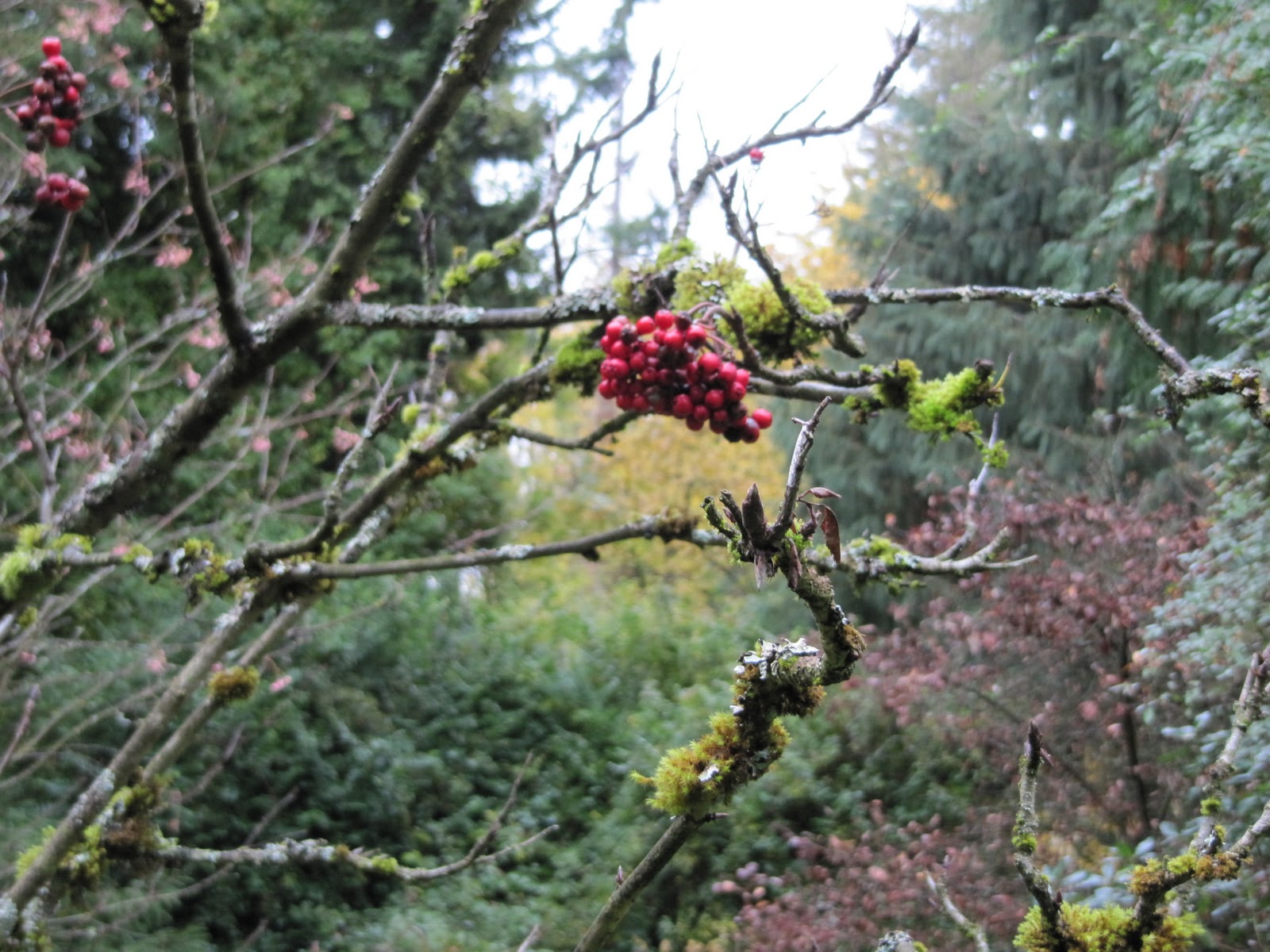
On our late fall walk along the Azalea Path, we not only saw beautiful fall leaves, but also mushrooms and berries and moss and even a few late flowers. Look!

Moss and Berries by Brad Gibson